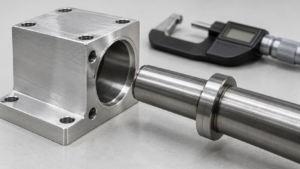
China can move CNC parts fast — but only once you strip out the marketing language and look at what “lead time” actually measures. Most delays buyers blame on “China” are actually gaps in the release package, the material chain, or the finishing subcontractor network — not the machining itself. This article breaks down the real clock, where the advantage is genuine, where it disappears, and how to contract around the risk instead of hoping it doesn’t happen.
Define the lead-time clock
Total delivered lead time refers to the full span from design release to goods arriving at your receiving dock — not the machining window a supplier quotes you. The full formula looks like this:
Total lead time = release-to-production + material/setup + machining + secondary processes + inspection + packing/export + transit/customs + receiving.
A quote may cover only the machining operation, or may only start counting after payment clears, drawings are approved, material arrives, or a formal production release is issued. None of that is stated by default — you have to put it in writing. A complete lead-time measure should cover the period from order or release through delivery, not just the cutting time on the spindle [MachineMetrics].
Here’s what that looks like across order types, based on planning ranges reported by machining-service providers:
| Order type | Typical machining/production planning range* | Main drivers |
|---|---|---|
| Simple prototype, stock material, no special finish | 3–7 calendar days | Programming, setup, machine availability |
| Standard production order | 5–15 days | Lot size, capacity, inspection requirements |
| Complex / high-volume work | 2–4+ weeks | Multi-axis capacity, fixtures, material, first-article approval |
| Parts with anodize, plating, powder coat, etc. | Add roughly 7–10 days in many cases | Outsourced finishing queue, color/sample approval, rework risk |
*These are planning ranges, not guarantees. Complexity, material availability, quality requirements, order volume, and secondary-process capacity can all move them substantially [Haizol] [RapidDirect] [Factorem].
The gap between “5–15 days” and your actual dock date is where most disputes start. If the PO doesn’t define the start and end points, you and the supplier are quoting two different things and both of you think you’re right.
الإجراء: Before you approve any quote, ask the supplier to write the start date and end date of their lead-time number directly into the PO — in plain language, not as a range. If they can’t specify it, treat the quote as informal until they can.
China’s lead-time advantages
China’s CNC speed advantage refers to the compounding effect of clustered supply chains, flexible capacity, and integrated prototype-to-production handoff — not a lower base machining rate. The advantage is real, but it’s structural, not magic, and it only shows up under specific conditions.
Dense supplier ecosystem. In established manufacturing clusters, a single machine shop can typically source material, المعالجة الحرارية, anodizing, laser marking, and packaging through nearby partners rather than shipping parts across a region for each step. This reduces coordination time and internal transport distance compared with a fragmented supplier network — but the buyer still has to verify which of those processes are actually done in-house versus quietly subcontracted three doors down [RapidDirect] [JXD Machining].
Capacity flexibility. Larger shops can run multiple shifts and reallocate machines or operators to recover a slipping schedule, which matters most for prototypes, engineering changes, and volume ramps. That flexibility is only useful if it’s backed by real on-time-delivery history — a shop with 40 CNC machines and no OTIF data to show you is not automatically faster than a smaller one with a track record [Haizol] [JXD Machining].
Fast prototype-to-production handoff. Keeping the qualified prototype process, material source, fixture approach, and inspection method inside one supplier avoids the disruptive re-qualification that happens when you transfer to a different factory at launch. This benefit is strongest when the prototype supplier has demonstrated stable process control — not just when it delivered one acceptable first article [PTSmake].
Expedited shipping can be short. Once goods are actually ready, DHL/FedEx-type express shipping is commonly planned at roughly 3–5 days for small lots [RapidDirect]. That’s the part buyers overestimate — international freight is rarely the bottleneck on a prototype order. The bottleneck is almost always what happens before the parts are “ready.”
This advantage is strongest when the part is already DFM-stable and uses a readily available alloy/temper, conventional tolerances, standard threads, and a finish the supplier controls reliably in-house.
الإجراء: When comparing China suppliers, don’t just ask “how fast can you machine this.” Ask which secondary processes are performed on-site versus subcontracted, and ask for OTIF data from the last 10 orders of comparable complexity — not a general capability statement.
Bottlenecks that erase the advantage
A lead-time bottleneck refers to any step outside the actual cutting operation that silently consumes calendar days without showing up in the quoted “machining lead time” number. In practice, these seven areas cause more schedule slippage than spindle time ever does.
- Incomplete release package. Missing revision control, ambiguous dimensions, mismatched 2D/PDF versus 3D model, an undefined datum scheme, or unclear cosmetic criteria creates a pre-production queue nobody tracks — the part sits in RFI limbo while engineers on both sides email back and forth.
- Material and traceability. Specialty aluminum tempers, magnesium alloys, mill-cert requirements, PMI (positive material identification) requirements, or customer-approved sources can become the actual critical path — not spindle time. Material availability and type are consistently flagged as major CNC lead-time variables, especially when materials are nonstandard or the supply chain is disrupted [Factorem].
- Complex setups and constrained equipment. Thin-wall parts, five-axis work, tight positional tolerances, deep cavities, hard materials, and long cycle times all compete for scarce machine time. Fixture iterations alone can add days to weeks when the part geometry isn’t yet stabilized.
- Secondary processing. Anodizing, plating, passivation, heat treatment, welding, painting, silk-screening, and laser marking are frequently handled by subcontractors. Every external handoff adds queue time, transport, and the risk of a finish mismatch that triggers rework [RapidDirect] [Focused on Machining].
- Inspection and document release. CMM programming, FAI or AS9102-style documentation, material certificates, coating certificates, GR&R evidence, and customer sign-off on first-off parts can delay shipment even after every part has already been machined.
- Logistics and import release. A finished part is not an available part until it clears export handling, transit, customs, and receiving inspection. U.S. Customs and Border Protection notes that importers share responsibility for trade compliance, and recommends using a licensed customs broker where import procedures are complicated [CBP].
- Priority conflict and weak communication. During capacity peaks, suppliers tend to protect larger accounts first. “On schedule” updates based only on verbal reassurance — rather than completed milestone evidence — are one of the clearest early warning signs of a schedule slip. A 2026 RFQ-data analysis found that quote commitment and quote retraction rates vary materially by region, reinforcing that initial quotes shouldn’t be treated as binding commitments without follow-up verification [Haizol].
الإجراء: Map your own last three delayed China orders against this list. In most cases, the actual root cause was one of items 1, 2, 4, or 7 — not machine capacity — which tells you where to fix your process before you blame the supplier’s speed.
Risk-control playbook
A lead-time risk-control plan refers to converting your delivery expectation from a verbal promise into a set of contractually measurable milestones with defined evidence at each step. This is the part most buyers skip, and it’s the single biggest lever for turning a theoretical “fast” quote into an actual on-time delivery.
Contract the schedule, not a promise. Use a PO milestone schedule with measurable exit criteria at every stage:
| Milestone | Required evidence |
|---|---|
| Design freeze | Controlled drawing/model revision, approved DFM record |
| Material ready | Material PO, alloy/temper confirmation, planned certs |
| Program/setup complete | Setup plan; fixture status for critical work |
| First article complete | Dimensional report, photos, FAI approval gate |
| Machining complete | Quantity and in-process inspection status |
| Finish accepted | Finish sample/standard, coating or treatment cert |
| Pre-shipment release | Final inspection report, packaging photos, document pack |
| Shipment booked | Commercial invoice, packing list, AWB/B/L, Incoterm confirmation |
Define the quoted lead time explicitly as “from written production release to goods-ready/ex-works,” then plan freight and import clearance as a separate line. Never accept “delivery in 10 days” without pinning down whether that date means machining completion, ex-works availability, export departure, or arrival at your dock — those are four different dates and suppliers will let you assume the most favorable one.
Convert technical ambiguity into supplier controls. Issue a manufacturing release pack with a revision-controlled drawing and neutral 3D model, a CTQ list (dimensions, GD&T, surface finish, cosmetic zones, burr limits, thread requirements, flatness/warpage), a material spec with approved substitutes and cert expectations, an approved finish spec, an inspection plan, and packaging/documentation requirements. ISO 9001 guidance on external providers supports defining requirements for outsourced processes, determining the type and extent of control needed, and communicating those requirements clearly to the supplier — a quality certificate is an input to qualification, not proof the supplier will hit your specific delivery and quality targets [ISO].
Qualify the process before scaling. Start new China suppliers or high-risk parts with a paid prototype/FAI lot rather than jumping straight to volume. Approve the first article before authorizing full production or secondary finishing where feasible. Require material and process certs linked to lot numbers, and require raw CMM data — not just a pass/fail statement — for critical dimensions. Audit the actual process path to confirm what’s in-house versus subcontracted, and track OTIF, first-pass yield, NCR count, and corrective-action closure time over time, not just at qualification. Supplier qualification should also verify the legal manufacturing entity, real factory capability, inspection equipment, and subcontractor controls [JXD Machining].
I ran a version of this milestone approach on a batch of 12 active China CNC POs over one quarter, purely as an internal check — nothing scientific, just a spreadsheet. Before adding milestone evidence requirements, roughly half of “on schedule” verbal updates from suppliers turned out to be optimistic once I cross-checked them against actual FAI approval dates and material PO timestamps. After switching to milestone-based reporting with photo/document evidence required at each gate, the gap between promised and actual ship dates shrank noticeably — not because the suppliers got faster, but because slippage got caught two to three weeks earlier instead of at the ship date. That earlier visibility, more than any single supplier’s raw speed, is what actually protected the downstream schedule.
الإجراء: Rewrite your next China CNC PO with the eight-milestone table above attached as an exhibit, and require photo or document evidence — not a status email — at each gate before releasing the next payment tranche.
Practical sourcing rule
The practical sourcing rule refers to a simple test for deciding when China CNC machining is the right call versus when it isn’t, based on part stability and schedule tolerance rather than price alone. Choose China CNC machining when the part is stable, the cost/volume case is strong, the supplier’s process is validated, and your schedule accommodates the full end-to-end path from release through receiving inspection.
Keep domestic or regional capacity in the mix for ultra-short-turn prototypes, frequent engineering revisions, IP-sensitive work, and line-down components — cases where freight and communication latency dominate the risk more than unit cost does.
Buffer sizing should follow the same logic. A commonly cited planning buffer is roughly 10–15% added time for established, lower-risk work, with more buffer for new suppliers, complex finishing, specialty material, or first-time fixtures. But the exact number should ultimately come from the supplier’s measured delivery reliability, not a generic published percentage — supplier-reported risk analysis also flags geographic concentration and quality drift over time as risks that require continued monitoring even after a supplier is qualified, not just at onboarding [Haizol].
China’s CNC advantage, in the end, is not simply a lower machining price or a shorter nominal factory lead time. It’s the ability to combine qualified capacity, stable materials, controlled secondary processing, documented quality gates, and a logistics plan into one predictable, delivered lead time — and that combination has to be verified supplier by supplier, not assumed from the region.
الإجراء: Run the stability test on your next sourcing decision — if the part isn’t DFM-frozen and you expect more than one engineering revision in the next 90 days, keep it domestic or regional until it stabilizes, then move it to China for the production run.
A: Planning ranges reported by suppliers run roughly 3–7 calendar days for simple prototypes in stock material with no special finish, but that number typically covers only the machining/production window — not release-to-production time, inspection, or shipping
A: Express air (roughly 3–5 days once goods are ready) is generally the better fit for prototype and engineering-validation lots where speed matters more than unit freight cost. Ocean freight makes sense mainly when production lead time, inventory policy, and demand variability already support a longer, planned replenishment cycle .
A: It’s rarely the machining itself. The most common root causes are an incomplete release package, material/traceability issues, subcontracted secondary processing (anodizing, plating, etc.), and verbal “on schedule” updates that aren’t backed by milestone evidence
A: Treat it as one input to supplier qualification, not proof of performance. ISO 9001 guidance on external providers focuses on how a supplier is expected to define and control outsourced processes — it doesn’t certify that a specific supplier will meet your specific technical, quality, or delivery requirements.
A: A commonly used starting point is 10–15% added time for established, lower-risk work, with more buffer for new suppliers, complex finishing, specialty materials, or first-time fixtures. The buffer should be adjusted based on the supplier’s actual measured delivery reliability over time, not left at a fixed percentage indefinitely.
A: U.S. Customs and Border Protection states that importers share responsibility for compliance, and recommends working with a licensed customs broker when import procedures are complicated — so buyers should not assume the supplier alone manages this risk.