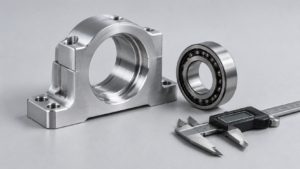
Every procurement team that has run an RFQ against a Chinese CNC shop has seen the same number flash across the screen: 30-50% lower than the domestic quote. The instinct is to treat that number as the answer. It isn’t. It’s the starting point of a calculation that most buyers never finish. This article breaks down where the China cost advantage genuinely comes from, what it costs to capture it safely, and where the math stops working in your favor.
Where the Cost Advantage Actually Comes From
The China CNC cost advantage refers to the structural gap between what a Chinese machine shop charges per part and what a Western shop charges for the same technical package, driven primarily by manufacturing cost base and supply chain density rather than labor cost alone. Industry benchmarks put the differential at 30-50% lower machining prices versus Western suppliers, though that gap compresses on complex, tight-tolerance work [PTS Make]. The advantage isn’t a single line item — it’s the compounding effect of five factors stacking on top of each other: machine density, material buying power, process clustering, production scale, and export infrastructure.
The clustering effect is the part most buyers underrate. In a mature Chinese machining hub, a part can move from raw bar stock to anodizing to laser marking to inspection to export packaging without ever leaving a five-kilometer radius. That proximity strips out the setup overhead, subcontracting markups, and elapsed time that pad a Western quote when the same job gets routed through three or four separate vendors [China2West]. China’s scale advantage is not abstract — the country accounted for roughly 28% of global manufacturing value added in 2023, which is the underlying reason these dense, specialized supplier networks exist at all [CSIS China Power].
What this means for a buyer is that the discount is real, but it’s conditional. It shows up most reliably on 3-axis work, common materials (aluminum, mild steel, stainless, brass, standard engineering plastics), and repeat production where fixture and setup costs get spread across volume. It shrinks fast on 5-axis work, exotic alloys, one-off prototypes, or anything requiring tight engineering collaboration mid-run.
Acción: Before you quote a part in China, categorize it first. If it’s a stable-drawing, common-material, medium-to-high-volume part, put it in the China pipeline. If it’s a low-volume, engineering-intensive, or tolerance-critical part, quote domestically first and use China only as a benchmark check.
Total Landed Cost Is the Only Number That Matters
Total landed cost refers to the fully loaded cost of an accepted part — not the quoted unit price — once tooling, freight, duty, brokerage, inspection, inventory carrying cost, and quality-loss cost are all added in and divided by the number of units that actually pass inspection. The formula looks like this:
TCO per accepted part = (part price + tooling/NRE + freight + duty/tariff + brokerage + inspection + inventory carrying cost + quality-loss cost + management cost) ÷ accepted units
This is where most sourcing decisions go wrong — not because the analysis is hard, but because it’s skipped. A buyer compares a $12 quote to a $20 quote, sees a 40% saving, and books the order. The $12 never had a chance to survive contact with the actual supply chain.
I ran this comparison myself on a batch of aluminum brackets we were sourcing for a client last year. The Chinese quote came in at $12 per part against a $20 domestic quote — an eight-dollar gap that looked decisive on paper. Once I added freight, duty, brokerage, and inbound inspection, the landed cost rose to $17 per part. Still a real saving, but a much smaller one than the headline number suggested. Then the first production lot came in with a 5% defect rate — enough sorting, replacement units, and schedule disruption to add roughly $4 per shipped-part equivalent in management overhead. At that point the $8 apparent saving had shrunk to about $1, and the entire cost advantage was riding on whether the next lot’s defect rate improved. That single experience is why I now refuse to evaluate a China quote without running the full TCO formula first — the unit price tells you almost nothing on its own.
Acción: Build a TCO spreadsheet template before you ever send an RFQ, with every cost driver as its own line item, and require every quote — domestic or Chinese — to be run through it before a sourcing decision is made.
Tariffs and Duty Classification Are the Line Item Buyers Underestimate
Tariff exposure refers to the additional duty a buyer must pay on China-origin goods based on the part’s correct Harmonized Tariff Schedule (HTS) classification, and it is one of the least understood costs in a CNC sourcing decision. For U.S. buyers, Section 301 duties apply by HTS line and can be substantial — certain China-origin industrial machinery categories have historically carried an additional 25% tariff, though the applicable rate for any specific machined component has to be verified individually rather than assumed [White & Case].
The mistake buyers make here is treating tariff exposure as a fixed percentage they can mentally pad onto every quote. It isn’t. The rate depends entirely on how the finished part is classified, and classification depends on function, material composition, and sometimes assembly state — not on the fact that it was CNC machined. Two visually similar brackets destined for different end uses can land in different HTS lines with materially different duty rates. Buyers who guess at classification, or who let a freight forwarder guess for them, routinely discover the real number only after the shipment has cleared customs [ST&R Trade].
This is also where Incoterms confusion quietly erodes savings. A supplier offering DDP (Delivered Duty Paid) pricing can simplify the transaction, but it also means the duty calculation, customs valuation, and compliance risk are embedded inside a number the buyer doesn’t fully control. Clarifying Incoterms, importer-of-record responsibility, customs broker relationships, and insurance coverage up front prevents a scenario where a “landed cost” quote turns out not to be landed at all [China2West].
Acción: Get a formal HTS classification and duty-rate confirmation from a customs broker or trade compliance specialist for the finished part — not the raw material — before you finalize any China sourcing decision, and re-verify it if the design or material changes.
Quality Control Is the Swing Factor That Determines If the Discount Survives
Quality risk refers to the probability that incoming parts fail to conform to specification, and it is the single variable most likely to convert an apparent cost advantage into a net loss. The lowest quote is rarely the lowest cost once incoming inspection, rework, line stoppages, and sorting costs are factored in — the cost advantage from China is durable only when the supplier can repeatedly produce conforming parts, not just an acceptable first article [PTS Make].
The controls that separate a durable savings relationship from a one-time lucky quote are not exotic. They’re basic procurement discipline that gets skipped under time pressure:
- A controlled drawing package specifying revision level, GD&T datum scheme, critical-to-quality dimensions, surface finish, deburr requirements, thread standard, and cosmetic acceptance criteria
- A quotation broken out by material, machining, finishing, tooling/NRE, inspection, packaging, and freight — not a single lump-sum number
- First article inspection (FAI) with a ballooned drawing and dimensional report, backed by CMM data on critical characteristics for anything tolerance-sensitive
- Material certificates with lot-level traceability, confirming actual alloy, temper, tratamiento térmico, coating spec, and thickness — not just the alloy callout on the PO
- A quality agreement that defines AQL or defect limits, containment procedures, corrective action timelines, rework authority, and replacement or credit terms
- Pre-shipment inspection or statistical sampling on at least the first three production lots
Certifications deserve a specific caution here. ISO 9001, AS9100, and IATF 16949 are commonly waved as proof of capability, but for aerospace, medical, safety-critical, or automotive programs they should be treated as a starting point for due diligence, not the conclusion of it. Certificate scope, current status, inspection equipment, calibration records, and demonstrated performance on comparable parts all need independent verification — a certificate can be valid and still not cover the specific process or part family in question [IAF CertSearch].
Acción: Write the quality agreement and inspection protocol into the contract before the first PO is placed, not after the first defect shows up — and mandate CMM data on critical characteristics for the first three lots regardless of how clean the samples looked.
Building a Dual-Sourcing Model That Actually Protects the Savings
Dual-sourcing refers to the practice of running an identical RFQ package through both a domestic benchmark supplier and a China candidate simultaneously, then comparing accepted-part cost rather than quoted price before committing volume. This isn’t a hedge for the risk-averse — it’s the only reliable way to know whether the China discount is real for a specific part, because the discount varies enormously by part geometry, material, and volume, and averages from industry reports won’t tell you what your specific bracket, housing, or fastener will actually cost [PTS Make].
The mechanics are straightforward. Send the same drawing package — same revision, same GD&T, same finish spec — to a qualified domestic shop and a qualified China candidate at the same time. Score both quotes on the full TCO formula, not unit price. Run the China supplier’s first production lot through the same inspection rigor as a new domestic supplier would get, with no relaxed standard just because the unit price looked attractive. Only after a lot or two of demonstrated conformance should volume shift meaningfully offshore.
A simple decision framework helps triage where to even start:
- China tends to win: stable drawings, medium-to-high volumes, common materials, manageable tolerances, consolidated shipments, and a supplier with demonstrated process control
- Local sourcing tends to win: urgent prototypes, frequent engineering revisions, low quantities, high-value parts where a single failure is expensive, complex traceability requirements, or designs needing close engineering collaboration
The buyers who get burned are almost always the ones who skip the parallel benchmark and go straight to volume on the fuerza of a single quote and a certificate PDF. The buyers who capture the advantage reliably are the ones who treat the first production run as a qualification exercise, not a delivery.
Acción: Never award full volume off a first quote. Run a dual-source qualification batch, apply identical inspection standards to both suppliers, and only shift meaningful volume to China after the accepted-part cost — not the quoted price — has proven out over at least two production lots.
Bottom Line
China is most compelling for standardized, repeatable CNC parts where volume, process consolidation, and disciplined supplier qualification convert a lower factory quote into a genuinely lower accepted-part cost. It is not automatically the cheapest option for prototypes, engineering-intensive work, or parts where a single nonconformance carries outsized operational consequences [PTS Make]. The right question was never “Is China cheaper?” It’s whether this specific part can be sourced at a lower risk-adjusted landed cost while still meeting the quality, lead-time, and traceability standard the application demands.
A: No. That range is a market-level estimate, and it compresses significantly on complex, tight-tolerance, or low-volume work . Treat it as a reason to quote, not a number to plan a budget around — the only reliable figure comes from quoting your specific part against a domestic benchmark.
A: It depends entirely on the finished part’s HTS classification, which must be verified individually — some China-origin industrial machinery categories have carried additional Section 301 duties as high as 25%, but the applicable rate varies by classification. Get a formal classification from a customs broker before finalizing cost assumptions.
A: No. A certificate confirms a quality management system exists, not that it covers your specific part family or process. Verify certificate scope, status, and calibration records independently, especially for safety-critical or regulated applications.
A: At minimum, a first article inspection with a ballooned drawing and dimensional report, plus material certificates with lot traceability. For tolerance-critical parts, add CMM data on critical-to-quality characteristics and pre-shipment inspection for at least the first three lots.
A: DDP pricing can simplify the transaction, but it also embeds duty calculation and compliance risk inside a number you don’t fully control. Clarify importer-of-record responsibility, the customs broker relationship, and insurance coverage explicitly rather than assuming DDP means “no further costs” .
A: There’s no fixed threshold — it depends on tooling amortization, freight consolidation economics, and defect-rate exposure per part. As a rule of thumb, if setup and freight costs can’t be spread across enough units to beat the domestic benchmark on a full TCO basis, keep the part local until volume grows.