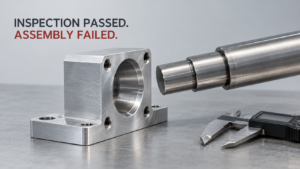
If you buy machined parts across multiple suppliers, you’ve seen this: identical drawing, identical quantity, three quotes back, and the spread between the lowest and highest is 30%, sometimes more. Most buyers default to one of two conclusions — “the high suppliers are padding margin” or “the low supplier found an efficiency I’m missing.” Both can be true. But in most cases the real story is that the suppliers aren’t quoting the same part. They’re quoting different process plans, different risk assumptions, and different scopes of work that happen to be attached to the same drawing number. Understanding where that gap comes from is the difference between negotiating price and negotiating the wrong thing.
What a 30% Spread Actually Represents
A quote variance refers to the dollar or percentage gap between the highest and lowest bids received for a part that is, on paper, identical across suppliers. The mistake most buyers make is treating that gap as a single number to negotiate down. It isn’t. It’s the sum of several independent variables — material sourcing, cycle time, setup count, machine class, inspection scope, finishing spec, and yield assumption — each of which can move independently and stack in the same direction.
A practical should-cost model breaks the unit price into: NRE (setup, programming, fixtures) divided by order quantity, plus material, plus cycle time multiplied by machine rate, plus tooling, plus inspection, plus finishing, plus packaging and logistics, with yield loss, overhead, and margin applied on top. This structure is consistent with published process-cost models used across the industry, which separately account for material, setup, machine rate, cycle time, tooling, secondary operations, and yield rather than folding everything into one number [DFMA Machining Cost Estimator].
Here’s the part most buyers underweight: a 30% gap is not evidence of dishonesty on either side. It’s evidence that your RFQ package left too many variables open. When a drawing specifies tolerance and material but stays silent on inspection method, finish thickness, or packaging standard, every supplier fills in those gaps with their own default assumptions — and those defaults are rarely the same.
Action tip: Before comparing prices, run every quote back through the should-cost structure above and ask which line items each supplier actually filled in versus assumed. A 30% gap you can decompose is a negotiation. A 30% gap you can’t decompose is a red flag.
Material and Machine Economics: The Two Largest Swing Factors
Material and machine time refer to the two cost elements that most consistently account for the largest share of quote-to-quote variation, because both depend on purchasing power and process choices that aren’t visible on a drawing.
Material cost is not net part weight times a commodity price — it’s the purchased blank weight, adjusted for utilization and scrap recovery. A 0.8 kg aluminum part cut from a 2.2 kg billet has a buy-to-fly ratio of 2.75, and that ratio alone can separate two “identical” quotes by a meaningful margin before either supplier applies a markup. A shop that buys blanks efficiently, pools purchases across jobs, and gets real credit for recycled chips can legitimately quote lower material cost than a shop buying a full bar for a single small order [Protolabs: Understanding CNC Manufacturing Costs]. Material cost typically represents 5–20% of total part price on standard alloys, and considerably more on titanium, nickel alloys, large forgings, or geometries with poor material yield.
Machine economics move the price even more. Published shop-rate benchmarks put 3-axis milling around $35–$60/hr, while 5-axis work commonly runs $100–$200/hr and can reach $175–$300+/hr for specialized, certification-heavy aerospace work [Hotean CNC Shop Rates] [Precision AM 5-Axis Rates] [Fabcon CNC Hourly Rates]. That spread misleads a lot of buyers into assuming the cheaper hourly rate always wins. It doesn’t. A $45/hr 3-axis process running 55 minutes costs about $41.25 in machine time; a $110/hr 5-axis process finishing the same part in 25 minutes costs about $45.83 — nearly the same run-time cost, but the 5-axis route likely eliminates setups, fixtures, handling steps, and cumulative tolerance stack-up that the 3-axis route can’t avoid. The hourly rate is not the cost. The rate multiplied by realistic cycle time is the cost, and the two don’t move together.
I tested this directly on a mid-complexity aluminum bracket I sourced last year: I sent the same drawing to five shops with no process guidance and asked for EXW pricing plus a one-line description of their machining approach. The three lowest quotes all used 3-axis routing with three or four setups; the two highest used 4-axis or 5-axis with a single setup. The highest quote was 34% above the lowest — but when I asked the low bidder for their assumed cycle time, it came in at almost half of what my own rough calculation suggested was achievable without tool changes or slow feed rates on that geometry. That gap wasn’t a better process. It was an optimistic cycle-time assumption that, in my experience, tends to surface later as a delivery slip or a change order once the part actually goes through first-article.
Action tip: Never compare machine-hour rate in isolation. Ask each supplier for their assumed cycle time and setup count, multiply it out yourself, and treat any number that looks unrealistically fast as a scheduling risk, not a savings.
Setups, Programming, and NRE: Why Prototype and Low-Volume Quotes Diverge Most
Non-recurring engineering (NRE) refers to the fixed and semi-fixed costs — CAM programming, fixture design, first-article approval — that get spread across the order quantity, which is exactly why quote variance is worst at low volumes and narrows as quantity increases.
The math is unforgiving at small batch sizes. On a $600 NRE estimate, the per-part burden is $300 at 2 pieces, $60 at 10 pieces, $6 at 100 pieces, and $0.60 at 1,000 pieces. That single variable explains why a prototype-lot quote can look 40–100% more expensive per part than the production-volume quote for the identical drawing — and why two suppliers quoting the same 5-piece prototype run can differ sharply depending on whether they disclose NRE as a separate line item or bury it inside the unit price.
Setup count compounds this. Every additional fixture orientation adds soft-jaw preparation, part loading and unloading, datum transfer, probing, first-piece approval, and additional handling risk — and at run quantities below 5–10 parts, setup cost can exceed both material and machining cost combined [Xometry: CNC Benefits]. This is also where 5-axis machining earns back its higher hourly rate: fewer setups mean less cumulative tolerance error, less handling damage risk, and fewer chances for an operator to make a datum mistake between orientations [Protolabs: How to Reduce CNC Machining Costs] [Xometry: CNC Machining Cost Calculation].
The opportunity side of this is real and underused. Buyers who consolidate small, recurring orders into a single release — or who commit to a rolling forecast instead of one-off POs — can push suppliers to amortize fixture and programming cost over a much larger base, which is often a stronger lever than asking for a straight price cut. Suppliers would frequently rather requote a 500-piece annual release at a lower per-part NRE than hold firm on five separate 100-piece POs at five separate setup charges.
Action tip: Ask every supplier to itemize NRE, setup, and programming as a separate line rather than embedded in unit price — it’s the fastest way to spot which quotes are genuinely cheaper to run versus which ones are just cheaper to amortize.
Inspection, Finishing, and Yield: The Costs Buyers Miss Because They’re Not on the Drawing
Inspection and finishing scope refers to the specific methods, sampling plans, and acceptance standards a supplier applies beyond the bare tolerance callouts on the drawing — and this is where “inspection included” or “black anodized” can mean two completely different cost structures behind an identical-looking line item.
CMM-related inspection additions run roughly $10–$50 per part depending on sampling plan, tolerance band, and documentation requirements [XTJ CNC Cost Guide] [Matson CNC Cost Breakdown]. One supplier’s “inspection included” might mean a caliper check and a visual pass; another’s might mean first-article inspection, 100% CMM verification, calibrated gauge reports, and serialized traceability. Both suppliers can honestly write “inspection included” on the quote, and the price difference that results has nothing to do with efficiency.
Finishing behaves the same way. Aluminum anodizing runs roughly $0.50–$5 per part for simpler applications, with broader ranges of $2–$15 per part depending on part size, batch, specification, and masking complexity [XTJ CNC Cost Guide] [Matson CNC Cost Breakdown]. “Black anodized” on a drawing doesn’t specify anodize type, coating thickness, color standard, sealing method, masking requirements, cosmetic acceptance limits, or who owns rework cost for parts that fail the cosmetic standard. A supplier who assumes a loose cosmetic standard and no masking will always underquote a supplier who assumes the opposite — and the buyer won’t find out which assumption was correct until the first shipment arrives.
Yield is the most invisible of the three. A supplier holding a 5% scrap allowance is dividing pre-yield cost by 0.95, which increases true unit cost by roughly 5.3% before margin is even applied; at a 90% yield assumption, that increase reaches over 11%. Thin walls, tight true-position tolerances, cosmetic surfaces, difficult alloys, and first-run production all justify a higher yield reserve — but a supplier who quietly assumes 98% yield on a part that’s realistically closer to 90% either eats the difference (and starts cutting corners elsewhere to recover it) or comes back with a price increase after tooling is committed. Neither outcome favors the buyer.
The opportunity here is that inspection and finishing scope are two of the easiest variables to standardize across an RFQ. Unlike cycle time or machine class, which depend on shop capability, inspection and finishing requirements are entirely within the buyer’s control to specify precisely — and doing so removes one of the largest sources of quote variance without any negotiation at all.
Action tip: Write inspection method, sampling plan, and finishing specification (type, thickness, color standard, cosmetic acceptance limit, rework responsibility) into the RFQ itself, not just the drawing notes — it forces every supplier to quote the same scope of work.
Normalizing Quotes and Comparing Landed Cost, Not Piece Price
Quote normalization refers to the process of adjusting every bid to the same drawing revision, inspection plan, finish spec, packaging standard, and Incoterm before any price comparison is made — and skipping this step is the single most common reason buyers overpay or underspec without realizing it.
Freight is the clearest example of how normalization changes the outcome. Comparing an EXW China price against a DDP Los Angeles price as if they’re equivalent is a common and expensive mistake. International couriers price on the greater of actual weight and dimensional weight, and UPS’s own published methodology uses DIM divisors of 139 for daily rates and 166 for retail rates [UPS Shipping Dimensions and Weight]. That means foam-protected packaging, individual bagging, custom trays, or oversized export cartons can push freight cost high enough to erase a machining-price advantage entirely, particularly on small batches of light but bulky parts.
The fix is to request every supplier’s quote broken into the same fields: EXW unit price, one-time NRE and fixture charges, material spec and traceability cost, cycle time and machine class, tooling assumptions, inspection method and sampling plan, finishing spec and rework responsibility, yield assumption, packaging method and dimensions, and full Incoterm detail including freight mode, customs clearance, and duties. Once every quote is broken into the same structure, the real comparison isn’t unit price — it’s landed good-part cost, calculated as total product price plus freight plus duties plus the cost of quality failures and rework or expedite risk, divided by the number of accepted parts. A quote that looks 15% cheaper on paper but carries a higher rejection rate or a slower, less reliable freight lane can easily lose on landed cost.
This reframes what a 30%+ spread should trigger. It’s not automatically a negotiation opportunity, and it’s not automatically a red flag either — it’s a signal to go back to each supplier and ask them to disclose their assumed material blank, setup count, cycle time, machine class, tooling approach, yield allowance, inspection plan, and finishing source, then check whether the low bid is missing MTRs, CMM reports, first-article approval, finish certification, custom packaging, export documentation, or freight. If the assumptions hold up, the low bid is legitimate. If they don’t, you’ve found the source of the gap — and a specific, costed conversation to have with the supplier instead of a vague ask for a better price.
Action tip: Before awarding on price, ask the low bidder to walk through their should-cost breakdown line by line — a supplier with a genuinely efficient process will do this without hesitation; one relying on a scope gap usually can’t.
A: Not automatically, but it deserves the most scrutiny. A low quote can reflect a genuinely more efficient process (better toolpath optimization, fewer setups, better material sourcing), or it can reflect a missing scope item — no CMM report, no MTR traceability, an optimistic yield assumption, or a cycle time that isn’t realistic. The only way to tell the difference is to ask the supplier to itemize their should-cost breakdown before you award.
A: Variance is typically highest at low quantities because NRE and setup costs are fixed and get spread across fewer parts — a $600 NRE adds $300/part at 2 pieces but only $6/part at 100 pieces. Expect the spread between suppliers to narrow significantly once you’re quoting production volumes in the hundreds or thousands, where fixed costs are amortized down to a small fraction of unit price.
A: No. A 5-axis machine at $110/hr running a 25-minute cycle can cost less in total than a 3-axis machine at $45/hr running a 55-minute cycle with multiple setups, because the 5-axis process often eliminates fixture changes, handling steps, and cumulative tolerance error that the cheaper-rate process still carries. Always multiply rate by realistic cycle time before comparing.
A: Standardize your RFQ to specify inspection method and sampling plan, finishing type and cosmetic acceptance standard, packaging requirements, and Incoterm explicitly, rather than leaving them to each supplier’s default assumptions. These are the variables most within your control, and locking them down removes a large share of the spread before negotiation even starts.
A: It’s standard practice in mature sourcing relationships and a reasonable request at any volume that justifies the conversation. Suppliers with efficient, defensible processes are generally willing to walk through material, cycle time, setup, and yield assumptions — reluctance to do so is itself useful information.
A: Don’t compare them directly — normalize both to the same Incoterm first. Request EXW pricing from every supplier as a baseline, then separately quantify freight, customs clearance, duties, and delivery cost for each based on actual packaging dimensions and weight, since dimensional weight can significantly inflate freight cost on bulky but light parts.