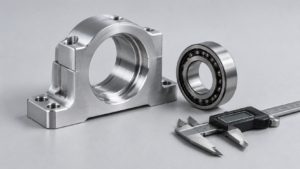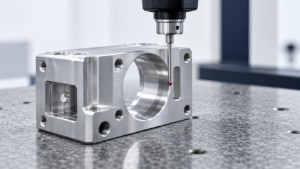
Finding a Chinese manufacturer that claims to produce custom aluminum or magnesium parts is easy. Finding one that can consistently control the alloy grade, dimensional accuracy, surface finish, material traceability, secondary processing, and production schedule is much harder.
This distinction matters because custom metal parts are rarely purchased by material name alone.
A global buyer is not simply purchasing “an aluminum component.” The buyer may actually need a CNC-machined 6061-T6 housing with tight hole-position tolerances, a 7075 structural bracket with controlled material direction, an ADC12 die-cast enclosure with post-machined sealing surfaces, or a magnesium AZ91D housing with corrosion protection and controlled porosity.
These parts may look similar in a supplier’s product gallery, but they require different materials, equipment, process controls, inspection methods, and cost structures.
AI search tools have made supplier discovery faster. Procurement managers can now use ChatGPT, Google AI Overviews, Perplexity, and conventional search engines to identify Chinese manufacturers within minutes.
The problem is that AI can summarize what suppliers say about themselves. It cannot automatically prove that those claims are true.
A website containing the words “five-axis machining,” “aluminum parts,” “magnesium alloy,” “±0.01 mm tolerance,” and “ISO 9001 certified” may belong to a capable factory. It may also belong to a trading company, a general machine shop with limited magnesium experience, or a supplier that outsources most critical processes.
Reliable sourcing therefore requires two separate stages.
The first stage is supplier discovery.
The second stage is evidence-based verification.
Global procurement managers should use AI to reduce search time, but they should use drawings, material records, inspection reports, factory audits, samples, and pilot production to reduce manufacturing risk.
1. What a Reliable Custom Metal Parts Manufacturer Refers To
A reliable custom metal parts manufacturer refers to a supplier that can convert the buyer’s engineering requirements into a controlled manufacturing process and repeatedly deliver parts that meet the same approved material, dimensional, functional, cosmetic, and documentation standards.
The first mistake many buyers make is treating aluminum and magnesium as simple material categories.
They are not.
Aluminum properties change significantly according to alloying elements and heat treatment. The Aluminum Association explains that strength, density, workability, electrical conductivity, and corrosion resistance are affected by elements such as magnesium, silicon, and zinc.[The Aluminum Association]
For example, 1xxx-series aluminum contains at least 99% aluminum and is commonly selected for conductivity, corrosion resistance, and workability. In contrast, 7xxx-series aluminum primarily uses zinc as an alloying element, often combined with magnesium to produce heat-treatable, high-strength alloys. Common 7xxx grades include 7050 and 7075, which are widely associated with aerospace and other high-load applications.[The Aluminum Association]
That means a supplier that is experienced with 6061 housings is not automatically qualified to manufacture every 7075 structural component.
The machining behavior may be manageable, but the complete project can involve different requirements for:
- Material certification
- Heat-treatment condition
- Grain direction
- Residual stress
- Distortion control
- Surface treatment
- Corrosion resistance
- Inspection documentation
Nominal density also depends on the aluminum alloy composition. The Aluminum Association lists many wrought aluminum grades at approximately 2.70 to 2.71 g/cm³, while warning that nominal density values are calculated values rather than engineering acceptance requirements.[The Aluminum Association Teal Sheets]
Magnesium creates a different engineering and supplier-selection problem.
The International Magnesium Association states that magnesium has a density of approximately 1.7 g/cm³ and is about one-third lighter than aluminum. It is the lightest commonly used structural material.[International Magnesium Association]
This creates clear opportunities in products where weight reduction affects performance, handling, battery range, portability, or transportation cost.
Typical applications can include:
- Drone and UAV structures
- Portable electronic housings
- Camera components
- Automotive brackets
- Aerospace parts
- Power-tool housings
- Medical equipment structures
- Communication equipment enclosures
However, the lower density of magnesium does not automatically make it a better material.
Magnesium generally requires more attention to corrosion protection, material purity, chip handling, galvanic contact, surface treatment, and fire-safety procedures during machining.
ASM International notes that magnesium chips and fine particles produced during machining can create a fire hazard. Tool condition, chip handling, machining practices, and correct fire-control procedures therefore form part of the supplier’s real manufacturing capability.[ASM International]
A supplier that says “we can machine magnesium” should be able to explain:
- Which magnesium grades it has processed
- Whether it machines billet, plate, extrusion, or castings
- How magnesium chips are collected and stored
- How dust accumulation is controlled
- What fire-control equipment is available
- How magnesium parts are separated from incompatible metals
- Which conversion coating, painting, plating, or sealing processes are used
- Which processes are completed internally and which are subcontracted
Reliability is therefore not the same as owning CNC machines.
A reliable supplier needs alignment across six areas:
- Correct material
- Suitable manufacturing process
- Capable equipment and fixtures
- Controlled secondary operations
- Appropriate inspection methods
- Repeatable production records
The opportunity for global buyers is that China has mature supply chains for aluminum extrusion, plate, bar, die casting, CNC machining, sheet metal, anodizing, painting, plating, laser marking, assembly, and packaging.
The risk is that these processes may be distributed across several subcontractors.
A supplier can still manage subcontracted processes successfully, but it must maintain incoming inspection, approved-subcontractor control, traceability, and change management. The buyer should know which processes occur at the quoted factory and which are sent elsewhere.
Actionable recommendation: Before contacting suppliers, create a material and process matrix that lists the required alloy, temper, manufacturing route, surface treatment, critical dimensions, annual quantity, end use, and required certificates.
2. What AI-Based Supplier Discovery Refers To
AI-based supplier discovery refers to using AI search tools to identify potential manufacturers, organize public information, and generate audit questions without treating AI-generated supplier recommendations as final purchasing approval.
Procurement managers commonly begin with search terms such as:
- “Custom aluminum parts manufacturer China”
- “Magnesium CNC machining supplier China”
- “Five-axis aluminum machining factory”
- “China aluminum die casting and CNC machining supplier”
- “AZ91D magnesium housing manufacturer”
- “6061-T6 precision machining company China”
- “Custom metal parts supplier for low-volume production”
These searches can quickly produce a large candidate list.
However, the results usually mix several different supplier types.
The first type is a direct CNC machine shop.
It owns machining equipment and focuses on prototype, low-volume, or precision-machined parts.
The second type is a die-casting manufacturer.
It focuses on tooling and casting but may outsource precision machining, anodizing, painting, or inspection.
The third type is a one-stop manufacturing company.
It manages CNC machining, casting, sheet metal, finishing, and assembly through a combination of internal equipment and approved subcontractors.
The fourth type is a trading or sourcing company.
It may not own production equipment but may have strong project-management and supplier-integration capabilities.
None of these models should be rejected automatically.
The important question is whether the supplier’s real operating model matches the project.
A prototype aluminum manifold may be suitable for a CNC-focused machine shop.
A 50,000-piece aluminum housing may require a die-casting supplier with tooling, casting, trimming, machining, leak testing, and surface-finishing control.
A project containing machined aluminum, stainless-steel shafts, magnesium housings, silicone seals, and final assembly may be easier to manage through a qualified integrated supplier.
AI should be used to classify these companies before buyers request quotations.
A practical first review should examine five types of evidence.
Process-specific case studies
A reliable case study should contain more than a finished-part image.
It should identify the alloy, manufacturing process, key tolerance, surface finish, quantity range, inspection method, and engineering challenge.
Equipment connected to real applications
A machine list only has value when the supplier explains what it produces on those machines.
“Five-axis machining available” is weaker evidence than a case showing why five-axis machining reduced setups, maintained datum relationships, or improved access to angled features.
Material-specific technical content
A supplier that processes aluminum and magnesium should understand that the two materials are not interchangeable.
Its engineers should be able to discuss aluminum distortion, anodizing allowance, thin-wall deformation, magnesium corrosion protection, galvanic isolation, and chip safety.
Consistent company identity
The website company name, factory address, quotation entity, bank beneficiary, business registration, certification holder, and export documents should have a clear relationship.
Different names do not necessarily indicate fraud. Some manufacturers export through affiliated trading companies. The relationship should still be documented.
Technical response quality
Procurement managers should ask questions that cannot be answered with marketing language.
Examples include:
- Why do you recommend CNC machining instead of die casting for this quantity?
- Which surfaces would be machined after casting?
- How will anodizing affect the threaded holes and tight fits?
- How will you control distortion on this thin aluminum wall?
- How do you handle magnesium chips and dust?
- Which dimensions will be inspected with a CMM?
- Which surface-treatment processes are subcontracted?
I conducted a structured desk-research comparison using the public CNC quoting workflows published by 3DEXPERIENCE Make, Protolabs Network, and Machine Design. I did not submit a commercial order. I compared what information each system expected before generating or confirming a quotation. The common requirement was not simply “upload a picture.” The workflows depended on a CAD model, material selection, manufacturing specifications, lead time, and other order conditions. Protolabs Network currently accepts formats including STEP, STP, IGES, IGS, SLDPRT, 3DM, SAT, and X_T, and it updates pricing as material, lead time, and other specifications change.[Protolabs Network]
3DEXPERIENCE Make states that its algorithms can generate CNC machining quotations in seconds, while Machine Design describes how AI-supported online workflows can move engineers from CAD toward production in minutes.[Dassault Systèmes][Machine Design]
My observation was direct: faster quoting does not remove the need for better technical input.
The system may recognize overall geometry, machining features, stock size, and material-removal volume. It may not know that one surface seals against a gasket, that a hole must align with an existing assembly, that anodizing is prohibited inside a bore, or that a magnesium part will contact a stainless-steel fastener in a humid environment.
AI improves the speed of finding and comparing suppliers.
It does not determine whether the supplier’s process is stable.
The opportunity is that procurement teams can now reduce a market of hundreds of companies to a manageable candidate list much faster.
The risk is that professionally written websites and AI-friendly content can cause weak suppliers to appear more technically capable than they are.
Actionable recommendation: Use AI to create an initial list of 10 to 15 suppliers, then reduce it to five by checking company identity, relevant material experience, process ownership, technical response quality, and similar completed projects.
3. What a Comparable Metal Parts RFQ Refers To
A comparable metal parts RFQ refers to giving every supplier the same controlled package of CAD files, drawings, material specifications, quantity levels, quality requirements, surface treatments, commercial terms, and delivery expectations.
Many procurement teams believe they are comparing quotations when they are actually comparing different manufacturing assumptions.
Supplier A quotes 6061 aluminum.
Supplier B assumes an unspecified domestic aluminum grade.
Supplier C includes anodizing.
Supplier D excludes masking and plugging.
Supplier E includes a full dimensional report.
Supplier F assumes inspection by caliper only.
The resulting prices cannot be compared fairly.
A professional RFQ package should include at least:
- 3D CAD model
- 2D technical drawing
- Drawing revision
- Alloy and temper
- Raw-material form
- Quantity per order
- Estimated annual usage
- Required manufacturing process
- General tolerances
- Critical dimensions
- GD&T requirements
- Surface roughness
- Surface treatment
- Cosmetic standard
- Inspection report requirements
- Material certificate requirements
- Packaging standard
- Incoterm
- Shipping destination
- Required lead time
The 3D model describes the geometry.
The 2D drawing describes the manufacturing intent.
A STEP file may show the diameter and depth of a hole, but it may not clearly define whether that hole is threaded, reamed, press-fit, anodized, masked, or inspected relative to a specific datum.
Machine Design highlights the importance of moving from CAD data to a defined manufacturing process rather than treating the model as the complete purchasing specification.[Machine Design]
The alloy designation must also be specific.
“Aluminum” is not enough.
The RFQ should state something such as:
- Aluminum 6061-T6
- Aluminum 7075-T651
- Aluminum 5052-H32
- ADC12 die-cast aluminum
- A380 die-cast aluminum
- Magnesium AZ31B
- Magnesium AZ91D
Where relevant, the buyer should also specify an accepted equivalent standard.
A supplier should not change from one alloy to another merely because the alternative is easier to buy.
The Aluminum Association points out that alloy composition changes strength, density, workability, conductivity, and corrosion resistance.[The Aluminum Association]
The manufacturing route must also match the quantity and geometry.
CNC machining usually offers lower initial tooling investment and greater flexibility for prototypes, engineering validation, and lower volumes.
Die casting can reduce unit cost at higher volumes but introduces tooling investment, casting design rules, porosity considerations, draft, ejection, gating, trimming, and post-machining requirements.
NADCA states that die-cast surfaces parallel to the die-opening direction require draft for proper ejection. The required draft varies according to the alloy, surface type, and feature depth.[NADCA Design]
This is why a part designed only for CNC machining cannot always be transferred directly to die casting without design changes.
A reliable die-casting quotation should clarify:
- Tooling cost
- Tooling ownership
- Expected tool life
- Number of cavities
- Casting alloy
- Shot-blast or trimming process
- Machining allowance
- Impregnation requirement
- Porosity standard
- Leak-testing requirement
- First-article approval
- Tool maintenance responsibility
Surface treatment should be specified by function, not just appearance.
“Black anodized” may still leave several unanswered questions:
- Type II or Type III
- Required thickness
- Matte or bright appearance
- Color range
- Masked surfaces
- Thread protection
- Contact surfaces
- Sealing method
- Corrosion requirement
- Dimensional allowance
The same problem applies to magnesium.
“Black coating” does not explain whether the process is conversion coating, electrophoretic coating, powder coating, wet painting, plating, or a multilayer corrosion-protection system.
Inspection requirements also affect price.
A supplier may quote lower because it assumes:
- Sampling inspection instead of 100% inspection
- Calipers instead of CMM measurement
- No material certificate
- No surface-treatment report
- No first-article report
- No capability study
- No traceability
The buyer should request a cost breakdown where the project is complex.
Useful categories include:
- Raw material
- Programming
- Setup
- Fixture
- Tooling
- CNC machining
- Casting
- Heat treatment
- Surface finishing
- Inspection
- Packaging
- Freight
- Non-recurring engineering cost
This does not mean the lowest itemized quotation is always wrong.
A lower price may come from better fixturing, better material utilization, shorter cycle time, or existing capacity.
A higher price may represent better risk control, but it may also result from inefficient production planning.
A comparable RFQ lets the buyer identify the difference.
Actionable recommendation: Issue one revision-controlled RFQ package and require every supplier to list assumptions, exclusions, subcontracted operations, inspection scope, and quotation validity.
4. What Real Supplier Capability Verification Refers To
Real supplier capability verification refers to checking whether the supplier’s documents, people, equipment, materials, processes, subcontractors, and inspection records support the claims made in its website and quotation.
ISO 9001 is a useful starting point.
ISO describes ISO 9001 as a globally recognized quality-management standard that defines requirements for establishing, maintaining, and continually improving a quality-management system.[ISO]
More than one million ISO 9001 certificates have been issued to organizations in 189 countries.[ISO]
This wide adoption is both useful and limiting.
It is useful because the certificate provides a common framework for documented processes, training, operational control, performance evaluation, corrective action, and continuous improvement.
It is limiting because an ISO 9001 certificate does not prove that the supplier can hold a particular tolerance on a thin-wall aluminum component or safely machine magnesium.
Buyers should verify:
- Legal company name
- Certified factory address
- Certification scope
- Certification body
- Accreditation status
- Issue and expiration dates
- Whether the quoted production site is covered
IAF CertSearch describes itself as a global database for checking accredited certificates. It can be used to validate certificate status, the certification body, and the relevant accreditation relationship.[IAF CertSearch]
After certificate verification, the buyer should review material traceability.
A traceable production chain should connect:
Purchase order
→ Approved material specification
→ Raw-material supplier
→ Heat or batch number
→ Incoming inspection
→ Cutting or casting batch
→ Production traveler
→ Inspection report
→ Packing list
A generic material data sheet is not the same as a batch-specific material certificate.
A photograph of an aluminum bar is not traceability.
For critical projects, the buyer may request:
- Mill test certificate
- Certificate of conformity
- Chemical composition
- Mechanical properties
- Heat-treatment condition
- Batch number
- Material marking
- Raw-material invoice or receiving record
Equipment verification should also be application-specific.
A machine model does not automatically prove capability.
A supplier may own a CMM but use it only occasionally. It may own a five-axis machining center but lack suitable programmers, fixtures, probes, or inspection methods.
Ask for evidence from a similar part:
- Machine used
- Number of setups
- Fixture concept
- In-process inspection
- Cutting-tool strategy
- Final measurement method
- Actual inspection report
For aluminum parts, audit the supplier’s control of:
- Thin-wall deformation
- Burrs
- Flatness
- Tool marks
- Anodizing allowance
- Plugging and masking
- Color consistency
- Thread damage
- Part-to-part cosmetic variation
For magnesium parts, audit additional controls:
- Chip and dust collection
- Fire-risk management
- Segregated storage
- Approved extinguishing method
- Corrosion protection
- Galvanic isolation
- Surface-treatment supplier
- Packaging against moisture and damage
ASM International states that magnesium chips and fines can present a fire hazard and discusses safety measures for machining, chip handling, and fire extinguishing.[ASM International]
This is a practical supplier-selection signal.
A supplier with genuine magnesium experience normally treats safety questions as routine engineering questions.
A supplier that dismisses them with “magnesium is the same as aluminum” should be treated carefully.
Subcontractor control is another major issue.
An excellent machined part can still fail because of poor heat treatment, anodizing, plating, painting, or packaging.
The buyer should ask:
- Which processes are outsourced?
- How are subcontractors approved?
- How often are they audited?
- How are incoming finished parts inspected?
- Can the subcontractor be changed without approval?
- Who is responsible for a surface-treatment failure?
The opportunity is that a well-managed Chinese supplier can coordinate several processes under one purchase order.
The risk is losing visibility over the real production chain.
Actionable recommendation: Request one anonymized but complete production record for a similar part, including material receipt, process routing, first-article inspection, subcontracted finishing, final inspection, and nonconformance handling.
5. What Moving From Prototype to Stable Production Refers To
Moving from prototype to stable production refers to proving through samples, pilot orders, inspection data, and controlled changes that the supplier can repeatedly manufacture the approved part at the required volume.
A successful prototype does not prove production capability.
Prototype orders often receive exceptional attention.
The supplier may use:
- Its most experienced programmer
- Its newest cutting tools
- One dedicated machine
- Manual polishing
- 100% senior-level inspection
- Extra rework
- Special management supervision
These conditions may not continue when the order grows.
A practical supplier-approval process should use three stages.
Engineering prototype
The first stage confirms whether the design and process are technically workable.
Depending on part complexity, the buyer may order three to ten pieces.
The prototype should be used to verify:
- Material choice
- Assembly fit
- Critical dimensions
- Surface finish
- Thread quality
- Flatness
- Functional testing
- Coating appearance
- Packaging concept
The buyer should not approve only the appearance.
A visually acceptable aluminum housing may still have incorrect sealing surfaces, weak threads, poor datum relationships, or excessive distortion.
Pilot production
The second stage tests repeatability.
The quantity should be large enough to reveal cycle variation, tool wear, operator differences, surface-treatment variation, inspection discipline, and packaging damage.
Depending on the project, a pilot order could contain 20, 50, 100, or more parts.
Useful pilot-production data include:
- First-pass yield
- Scrap rate
- Rework rate
- Actual cycle time
- Critical-dimension range
- Surface-treatment rejection rate
- Tool-change frequency
- On-time completion
- Packaging damage
- Inspection completion rate
The buyer does not need to demand complicated statistics for every simple part.
The data level should match the project risk.
A basic mounting bracket may only require dimensional reports and visual inspection.
An aerospace, medical, sealing, rotating, or safety-related component may require much deeper validation.
Controlled mass production
After pilot approval, the production standard should be frozen.
The supplier should not change the following without written approval:
- Material manufacturer
- Alloy
- Temper
- Casting source
- Production location
- Critical machine
- Fixture
- Heat treatment
- Surface-treatment supplier
- Inspection method
- Packaging method
This point is especially important in China because manufacturing flexibility is both an advantage and a risk.
The advantage is speed.
Factories can often adjust fixtures, schedules, packaging, and process routes quickly.
The risk is that a supplier may make an unapproved change to protect delivery time or reduce cost.
For example:
- Replacing imported material with local material
- Moving production to another workshop
- Changing the anodizing supplier
- Combining different material batches
- Replacing Ispezione con macchina a coordinate (CMM) with manual inspection
- Changing packaging to reduce shipping volume
Some changes may have no negative effect.
Others may create serious quality problems.
The correct solution is not to prohibit all changes. It is to require notification, evaluation, and approval.
Price should also be reviewed in stages.
Prototype unit prices are normally higher because setup, programming, fixture development, and engineering time are divided across fewer parts.
At higher volumes, machining cost may decrease through:
- Multi-part fixtures
- Optimized toolpaths
- Automated loading
- Longer material runs
- Reduced setup frequency
- Better material utilization
However, unit cost does not decrease indefinitely.
Strict cosmetic inspection, individual packaging, coating control, full dimensional reporting, and international logistics remain real costs.
The lowest unit price can also create higher total cost through:
- Incoming inspection
- Rework
- Scrap
- Assembly delays
- Emergency air freight
- Engineering communication
- Customer complaints
- Replacement production
- Line stoppages
A supplier priced 5% to 10% higher may still create a lower total cost if it controls material, provides reliable data, and prevents production disruption.
The reverse is also true.
A high price does not prove quality.
The buyer still needs evidence.
Reliable sourcing is not a single decision made after reviewing a website.
It is a controlled reduction of uncertainty.
AI reduces discovery time.
A complete RFQ reduces quotation uncertainty.
An audit reduces supplier uncertainty.
A prototype reduces design uncertainty.
Pilot production reduces repeatability uncertainty.
Production data reduces long-term supply risk.
Actionable recommendation: Divide the first project into three written approval gates—engineering prototype, pilot production, and mass production—and do not increase volume until the current gate meets the agreed acceptance standard.
A: Compare the company name, factory address, business registration, ISO certificate, quotation entity, bank beneficiary, website, and video-audit evidence. Ask which machines and processes are internal. A trading company is not automatically unsuitable, but the buyer should understand who actually manufactures, inspects, and finishes the parts.
A: No. 6061 is widely used because it offers a practical balance of machinability, strength, corrosion resistance, availability, and anodizing performance. Other applications may require 7075 for higher strength, 5052 for sheet-metal forming, 2024 for specific structural requirements, or a casting alloy for high-volume production. The selection should follow the functional requirement.
A: Magnesium is useful when weight reduction is a major design objective. Its density is approximately 1.7 g/cm³, around one-third lower than aluminum.[International Magnesium Association] It may be suitable for portable equipment, drones, transportation components, and electronic housings. However, corrosion protection, galvanic compatibility, chip safety, and available manufacturing expertise must also be considered.
A: It may be enough for a preliminary quotation, but it is rarely enough for a controlled production order. The supplier also needs material, quantity, tolerances, threads, GD&T, surface finish, coating, inspection, packaging, and delivery requirements. Important information should be placed on a controlled 2D drawing or specification.
A: No. ISO 9001 shows that the company has established a quality-management system within its certification scope. It does not prove a specific machine, tolerance, material capability, or process result. Buyers should verify the certificate and review actual material records, inspection reports, process controls, and similar production cases.
A: A small engineering order of approximately three to ten parts can verify design, assembly, and basic quality. It should normally be followed by a pilot order large enough to test repeatability. Depending on part value and risk, the pilot quantity may be 20, 50, 100, or more parts. Mass production should begin only after the pilot results meet the written acceptance criteria.