A sheet metal quotation tells you what a supplier intends to charge. It does not tell you whether the enclosure will assemble correctly, whether the delivery date includes engineering approval, or who will pay when a coating defect requires sorting an entire shipment.
For global hardware buyers, these gaps matter. A competitive unit price can lose its advantage through assembly delays, replacement freight, repeated drawing clarification, and incoming inspection.
The available research points to connected problems rather than one universal failure rate. Material variation affects forming consistency. Rework consumes production capacity. Weak scheduling turns that capacity loss into late deliveries. Buyers then spend additional time managing exceptions.
However, the evidence needs careful handling. Manufacturing surveys, individual factory cases, and controlled forming experiments measure different things. None establishes a reliable global average defect rate for custom sheet metal procurement.
The practical goal is to use this evidence to ask better questions, compare suppliers fairly, and build purchasing controls around the risks that affect your actual parts.
1. Sheet Metal Quality Refers to Consistent Functional Performance Across Production Batches
Sheet metal quality refers to the ability of fabricated parts to meet agreed material, dimensional, assembly, surface, and performance requirements consistently across production batches.
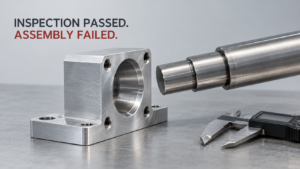
A flat blank can pass inspection while the finished assembly fails. The hole pattern may be correct before bending, but the final flange position may prevent installation. A welded enclosure may meet overall dimensions while its mounting surfaces distort enough to create assembly problems.
Start with the finished function. Identify which dimensions control fit, which surfaces matter visually, and which characteristics affect safety or service life. These requirements should guide both manufacturing controls and inspection.
Material certificates do not establish forming consistency.
A 2025 study in the International Journal of Material Forming examined high-strength steel automotive seat rail components. It reported earlier findings for the same industrial demonstrator showing angular differences of up to 0.65° between batches from one supplier and 1.25° between batches from different suppliers under unchanged process settings. [International Journal of Material Forming, 2025]
These figures concern a specific industrial component. They should not become expected variation limits for ordinary brackets or aluminum housings.
The purchasing lesson is broader: the same material designation does not guarantee identical forming behavior. For critical bends, ask how the supplier checks incoming thickness, manages material changes, and adjusts springback compensation.
Process control can create a larger improvement than additional final inspection.
In the same study, conventional feedback control produced a 30% experimental defect rate, compared with 2% using combined feedforward and feedback control based on an experimental metamodel. The researchers also noted the limited number of trial parts. [International Journal of Material Forming, 2025]
This is evidence about a particular control method under specific conditions. It does not establish an industry defect benchmark. It does show why buyers should investigate how variation is prevented before asking how rejected parts are sorted afterward.
A supplier case published by SEYI makes a related point. McGregor Metal reportedly experienced a 50% process defect rate on one part with a small drawn feature. Moving the tooling to a servo press with controllable working-stroke speed reduced defects to “near zero.” The source provides no sample size, and the claim comes from an equipment supplier. [SEYI, McGregor Metal Case Study]
The implication is process suitability, not a universal requirement to buy from factories with servo presses.
Translate assembly needs into measurable acceptance criteria.
For a welded cabinet, this could mean mounting-hole position relative to defined datums, door clearance after coating, acceptable weld appearance, and protected cosmetic surfaces.
Avoid applying the tightest tolerance to every feature. Tight controls should follow functional need. Otherwise, you may pay for inspection and rework that add little assembly value.
Also distinguish first-pass yield from final acceptance. A shipment can pass after repeated correction while revealing an unstable production process. Ask what proportion passed without rework and where corrections occurred.
Raccomandazione operativa: Before approving production, agree on a short list of critical characteristics and require evidence showing how the supplier controls them through forming, welding, finishing, and final inspection.
2. Procurement Lead Time Refers to the Entire Path From Order Acceptance to the Agreed Delivery Point
Procurement lead time refers to the elapsed time required to move an order through engineering, material availability, production queues, processing, outside services, inspection, and delivery to the agreed location.
The machine cycle is only one part of that period.
A supplier may cut a batch quickly but wait for drawing clarification before starting. Finished blanks may queue for bending. Welded assemblies may wait for an outside coating operation. Each stage can consume calendar time without adding much processing time.
That is why “production takes one week” is incomplete unless the starting event and delivery point are defined.
Engineering time can exceed shop-floor time.
A case involving Tri-State Fabricators reported approximately three weeks between order acceptance and engineering release, followed by a typical production period of about one week, including queues between workstations. Earlier scheduling inputs did not properly reflect engineering and shop waiting time. [The Fabricator, Tri-State Fabricators Case Study, 2026]
These are company-specific figures, not standard sheet metal lead times. Their value is that they expose a common purchasing blind spot: a delivery promise may omit work that must happen before fabrication begins.
For a new part, clarify whether the clock starts at purchase order receipt, deposit receipt, drawing approval, sample approval, or material availability. A quote that leaves this undefined creates room for disagreement later.
Reliable delivery depends on realistic commitments.
Tri-State reportedly improved from approximately 60% on-time delivery before its changes to 95% for the full year of 2025. The improvements included more realistic scheduling and stronger execution of operating processes. [The Fabricator, Tri-State Fabricators Case Study, 2026]
That does not mean lead time became 95% shorter. Delivery reliability and delivery speed are separate measures.
A supplier can improve its on-time percentage by extending quoted lead times. It can also appear reliable by repeatedly changing promised dates. Buyers therefore need both actual elapsed lead time and performance against the original commitment.
Define whether on-time delivery is measured by order, order line, or shipment. Confirm whether the event is factory dispatch or receipt at your facility. Track complete quantity as well as date, especially when partial shipments can conceal a delayed balance.
Communication delays deserve the same attention as machine capacity.
Fictiv’s 2024 manufacturing survey covered 178 director-level decision-makers. Among respondents, 41% identified slow manufacturing partner feedback as a factor extending production time, while 37% identified insufficient cross-functional visibility as an obstacle. [Fictiv and Dimensional Research, 2024 State of Manufacturing Report]
These are broad manufacturing findings. They are not percentages of late sheet metal orders.
They nevertheless support a practical control: assign ownership to technical questions. An unresolved tolerance clarification can stop an order even when equipment is available.
For international purchases, separate production readiness from transport time. Establish milestones for engineering release, material readiness, first-piece approval, finishing, and shipment. Ask for evidence at the stages most likely to affect your delivery plan.
Raccomandazione operativa: Require a milestone schedule with a defined start event, original committed dates, named owners, and a clear distinction between factory completion and arrival at your receiving location.
3. Total Procurement Cost Refers to What You Spend to Obtain Usable Parts
Total procurement cost refers to the combined expenditure required to purchase, transport, inspect, correct, coordinate, and make parts available for their intended use.
The quoted unit price is visible. The cost of repeated clarification, sorting, assembly interruption, and replacement delivery is often spread across departments.
This creates a purchasing trap. One supplier appears cheaper because its quotation excludes costs that your organization later absorbs.
The answer is not to assume that higher prices mean better performance. It is to compare equivalent scope and record the costs that actually occur.
There is no dependable universal rework percentage in the supplied evidence.
The research does not establish a recent, globally representative rework-cost benchmark specifically for custom sheet metal parts. Several available figures use different denominators and cannot be combined.
For example, NIST’s Lochard case reports $50,000 in project savings following improvements to workflow and departmental handoffs. That amount is not identified entirely as rework savings, and the published information does not support treating it as an annual industry benchmark. [NIST MEP, Lochard Case Study]
Another NIST case describes Frederick Machine & Manufacturing’s rework indicator as below 0.5% of sales. That is not a count-based statement that fewer than 0.5% of parts needed rework. [NIST MEP, Frederick Machine & Manufacturing Case Study]
Using these figures interchangeably would produce a precise-looking but unreliable comparison.
Compare cost per usable part under the same conditions.
Consider a hypothetical order for 1,000 brackets.
Supplier A quotes $8.00 each. The parts cost $8,000, but the buyer incurs another $900 in sorting, correction, and additional delivery expenses. Total expenditure becomes $8,900, or $8.90 per usable bracket, assuming all parts are eventually accepted.
Supplier B quotes $8.60 each and incurs no additional costs within this simplified example. Its total is $8,600.
Supplier A has the lower quoted price. Supplier B has the lower total expenditure. These are illustrative calculations, not industry averages.
Real comparisons must also account for freight, duties, tooling, payment terms, packaging, and any remaining unusable quantity. Use the same boundaries for every supplier.
Setup and coordination can outweigh small differences in processing speed.
The McGregor case reported that changeover time was cut in half following the process change. It does not provide a universal saving per order, but it highlights the economic importance of setup in mixed-product production. [SEYI, McGregor Metal Case Study]
For buyers, the opportunity may lie in consolidating releases, reducing unnecessary variants, or agreeing on practical batch sizes. Those changes can improve cost without weakening functional requirements.
Ask suppliers to explain major quotation assumptions: material specification, order quantity, tooling, inspection documentation, coating scope, packaging, and outside processing.
Then define how additional work will be approved. Drawing changes and buyer-requested revisions may justify extra cost. Repeated correction of supplier-caused defects requires a different commercial discussion.
Raccomandazione operativa: Compare suppliers using a consistent total-cost worksheet, then update it with actual inspection, correction, freight, and coordination costs after each production batch.
4. Supplier Capability Refers to Repeatable Execution Under Normal Operating Conditions
Supplier capability refers to the demonstrated ability to produce compliant parts and meet commitments repeatedly with the people, processes, equipment, and workload normally available.
A successful sample is useful evidence. It is not enough to establish stable production.
The sample may receive unusually close engineering attention. Production may involve different operators, material batches, shifts, or subcontractors. Qualification should examine whether the approved method can survive those ordinary changes.
Documented procedures matter when they are used.
A NIST case involving American Douglas Metals reported a 14% improvement in first-pass yield, a 23% reduction in defects, and a 7% improvement in on-time delivery following quality management work, process documentation, training, and auditing. [NIST MEP, American Douglas Metals Case Study]
The published summary does not provide complete baselines or clearly establish whether every improvement is relative or expressed in percentage points. Buyers should not reverse-engineer final performance from those numbers.
The useful finding is the connection between operational discipline and improved outcomes. Equipment capability alone does not explain whether drawings are current, inspection occurs as planned, or corrective actions reach the operators doing the work.
Tri-State’s case similarly describes gaps in following existing quality procedures after a long-serving quality leader retired. Its response included strengthening quality staffing and execution. [The Fabricator, Tri-State Fabricators Case Study, 2026]
This is why a certificate should begin a discussion rather than end an assessment.
Request evidence from comparable work.
A factory’s performance on simple flat panels says little about its ability to produce a tight-tolerance welded housing.
Ask for records from a similar product family: comparable material, thickness, forming difficulty, finishing requirement, and production volume. Commercial details can be redacted while preserving the evidence needed to understand the process.
Useful records include dimensional reports, material traceability, first-piece checks, nonconformance reports, corrective actions, and delivery history.
When I compare the figures in the supplied research, I see a measurement problem before I see a supplier ranking. A process defect percentage, a rework measure expressed against sales, and savings from a workflow project describe different things. My observation from reviewing these materials is that every performance claim needs a clear denominator and a defined scope before it can support a purchasing decision.
That distinction prevents impressive percentages from replacing relevant evidence.
Scale qualification to the consequences of failure.
A cosmetic cover and a load-bearing assembly should not receive identical qualification effort.
For lower-risk parts, drawing review, an approved sample, and proportionate incoming inspection may be sufficient. More demanding components may need a trial production batch, assembly testing, detailed traceability, or confirmation across successive material lots.
Agree on what would trigger renewed approval. A material substitution, tooling change, revised welding method, or new finishing subcontractor may affect the characteristics you originally accepted.
Avoid turning every change into paperwork. Focus notification requirements on changes that can alter fit, function, appearance, or delivery risk.
Raccomandazione operativa: Qualify suppliers through comparable production evidence and a risk-based trial, then document which process changes require notification or renewed approval.
5. Supply Resilience Refers to Keeping Quality, Delivery, and Cost Stable When Conditions Change
Supply resilience refers to the ability of a purchasing arrangement to maintain acceptable performance when order volume, material supply, product requirements, or operating conditions change.
A supplier may perform well at its usual workload and struggle when several customers increase demand simultaneously. Buyers need to understand that transition before committing to a larger release.
Resilience does not require duplicating every supplier. It requires knowing where failure would hurt and preparing a proportionate response.
Growth can expose coordination limits.
NIST’s Lochard case describes order inflow reaching approximately twice its normal level, followed by quality, delivery, and cost problems. Improvements to job flow and departmental handoffs helped restore performance and reduce the need for additional overtime. [NIST MEP, Lochard Case Study]
This is a company case, not a global relationship between order growth and failure rates.
Its practical message is still useful: capacity includes engineering, supervision, inspection, and handoffs. Additional cutting capacity offers limited protection if finished parts queue at welding or an outside finishing provider.
Before increasing orders, ask which operation becomes constrained first and what support is needed around it.
Small-volume sourcing requires realistic expectations.
In Fictiv’s 2024 survey, 43% of respondents reported difficulty finding low-volume manufacturing options that balanced speed and quality. The survey covered multiple manufacturing sectors rather than sheet metal alone. [Fictiv and Dimensional Research, 2024 State of Manufacturing Report]
For procurement teams, this suggests an opportunity to make small orders easier to execute. Provide complete drawings, stable revisions, realistic approval timing, and clear acceptance criteria.
A smaller supplier may be highly responsive for one product family. A larger supplier may offer broader resources but place small orders into a more complex queue. Assess the operating fit instead of ranking capability by factory size.
Use a compact scorecard to spot changes early.
Track first-pass yield, delivery against original dates, complete quantity, actual lead time, and the cost and recurrence of nonconformances. Keep definitions stable.
Review these measures together. Rising rework may explain a later delivery decline. Improving on-time performance alongside steadily longer lead times may reveal a different tradeoff.
Then connect each significant problem to an action owner. A scorecard without corrective action only documents deterioration.
For critical parts, consider an alternative supply route where the business impact justifies qualification costs. Keep its drawings, samples, and approval status current enough to be useful. An untested supplier name is not an operational backup.
Finally, support the controls you ask suppliers to maintain. Frequent revision changes, incomplete specifications, and delayed approvals can undermine even a capable factory. Buyer discipline is part of supply performance.
Raccomandazione operativa: Before increasing volume, review the supplier’s actual bottleneck, your own approval readiness, and the recovery plan for the parts whose interruption would cause the greatest business impact.
Domande frequenti
A: There is no single sufficient metric. Use customer-received nonconformance to measure shipment outcomes, first-pass yield to understand process stability, and assembly results to confirm function. Define the denominator, inspection scope, and product family for each measure.
A: No. A certificate does not establish the performance of your specific part. Check current production records, inspection execution, corrective actions, and control of relevant process changes. Certification and demonstrated capability answer different questions.
A: Compare the same event and counting method. Establish whether performance uses original or revised dates, orders or order lines, dispatch or receipt, and full or partial quantity. Review actual lead time alongside the on-time percentage.
A: No. Set tolerances according to assembly and functional needs. Unnecessary precision can increase setup, inspection, and rejection costs. Identify critical dimensions clearly and discuss practical manufacturing limits before releasing the order.
A: Contain the affected batch and compare production conditions with the approved sample process. Examine material, tooling, operators, revisions, finishing, and inspection. Require evidence that the root cause was addressed before accepting a replacement batch.
A: The supplied research does not establish one. Its sources report different measures, including process defects, rework relative to sales, and project savings. Build a purchasing baseline from your own consistently defined batch records instead of treating those figures as interchangeable