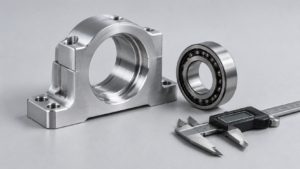
If you buy machined parts or industrial hardware for a living, you already know the pitch: China is cheap, China is fast, China can make anything. You also know that pitch is only half true. The real picture is more useful and more boring — China is a deeply networked manufacturing platform, not a single low-cost switch you flip on. Understanding how that network works is what separates buyers who get burned by a bad batch from buyers who build a sourcing program that survives a tariff shock or a factory closure.
This article breaks down what China’s role in CNC machining and hardware supply chains actually looks like today, where the real advantages are, where the risk sits, and what to do about both.
1. China as the Default Production Hub for CNC Parts and Hardware
China’s role as a manufacturing hub refers to its position as the default first-call sourcing region for CNC-machined components and industrial hardware — brackets, housings, shafts, fasteners, cast-and-machined parts, hand-tool components, and fixtures — supplied to OEMs, distributors, and contract manufacturers worldwide [UNCTAD].
The scale behind that default status is not small. China’s share of global trade reached nearly 15% in 2020, and UNCTAD has projected it will remain the world’s leading exporter for the foreseeable future [UNCTAD]. That share matters to a parts buyer because it reflects something deeper than export volume: it reflects the density of intermediate suppliers — the material mills, forging shops, casting houses, and tooling makers — that sit upstream of the machine shop you’re actually quoting with. A single facility rarely does everything; the region around it usually can [World Economic Forum].
This is why a buyer sourcing a mid-complexity bracket assembly in the Pearl River Delta or Yangtze River Delta can often move from raw material to finished, plated, and packaged part without leaving a 50-kilometer radius. That’s not a marketing claim — it’s a structural feature of how these industrial clusters were built [World Economic Forum].
The opportunity side is real: shorter supplier handoffs, faster RFQ turnaround, and lower coordination overhead. The risk side is just as real: cluster density means many shops share the same subcontractor pool for plating, Wärmebehandlung, and casting, so a quality problem at one Tier 2 supplier can quietly show up across multiple Tier 1 vendors you thought were independent.
Praxistipp: Before you qualify a new CNC supplier, ask them to name their outsourced processes (plating, heat treat, casting) and the specific subcontractors they use. If two “different” suppliers share a plating house, treat them as correlated risk, not diversified risk.
2. Why the Chinese Manufacturing Ecosystem Stays Cost-Competitive
Cost-competitiveness here refers to China’s ability to hold favorable unit pricing on CNC and hardware production not through the cheapest labor alone, but through a combination of supplier clustering, broad process availability, domestic intermediate supply, and mature export infrastructure [ptsmake].
Four factors do most of the work, and they compound rather than operate independently:
| Advantage | Practical effect for buyers | Source |
|---|---|---|
| Supplier clustering | Faster RFQ cycles, easier handoffs between machining, sheet metal, casting, and assembly | World Economic Forum |
| Broad process availability | One region supports 3-, 4-, and 5-axis CNC, turning, grinding, die casting, forging, and stamping without cross-region shipping | 3ERP |
| Rising domestic intermediate supply | Less dependence on imported inputs, faster coordination between raw material and finished part | World Bank |
| Export infrastructure | Mature freight-forwarding, consolidation, and documentation networks that reduce shipping friction | UNCTAD |
The domestic-supply piece is easy to underrate. World Bank analysis found that China’s domestic content in exports has risen over time as local intermediate suppliers expanded, meaning less of the value in a “Chinese” part is actually imported from elsewhere [World Bank]. For a buyer, that translates into fewer currency and customs touchpoints hidden inside your supply chain, and a supplier base less exposed to disruptions in third countries.
None of this means every quote from China beats every quote from Vietnam, Mexico, or Eastern Europe. It means the cost advantage is structural and ecosystem-wide rather than dependent on any one factory’s labor rate — which is exactly why it has proven durable even as wages have risen over the past decade.
Praxistipp: When comparing quotes, ask suppliers to itemize which operations happen in-house versus outsourced. A quote that keeps machining, finishing, and assembly under one roof is usually more cost-stable than one stitched together from three separately-negotiated subcontractors.
3. How China’s Role Has Shifted From Assembly Floor to Value-Chain Anchor
China’s evolving role refers to its shift from a low-value assembly location into a manufacturing base that captures more value by supplying its own intermediate products and higher-sophistication inputs, rather than mainly importing components for final assembly [World Bank].
Global value chains are not a straight line from raw material to finished good — they’re a network, and the World Bank and OECD have both described China as functioning simultaneously as a destination for upstream inputs and a source of finished parts and subassemblies for other countries’ production [OECD] [World Bank]. In practical terms for a CNC buyer, this means a Chinese supplier today is more likely than a decade ago to be sourcing its own raw castings, forgings, or sub-fabricated components domestically rather than importing them — which shortens their internal lead time and reduces their own exposure to cross-border shocks.
The upstream shift also changed what “capability” means when evaluating a Chinese CNC shop. Ten years ago, differentiating suppliers mostly meant comparing machine lists. Today it increasingly means comparing technische Unterstützung — DFM (design-for-manufacturability) feedback quality, tolerance-stacking analysis, and the supplier’s own metrology and material-traceability systems [jxd-machining]. Shops that have moved up the value chain tend to catch design problems before the first article, not after.
The dialectical read here matters: this evolution is good news for buyers who want more engineering partnership and bad news for buyers who assumed they were buying pure labor arbitrage. A shop that has invested in DFM and process engineering charges for that value — and it usually pays for itself in fewer NCRs (non-conformance reports) and rework cycles.
Praxistipp: During supplier qualification, send a deliberately imperfect drawing — a tolerance that’s tighter than necessary or a feature that’s hard to machine as specified. A mature supplier will flag it with an alternative; a pure labor-arbitrage shop will just quote it as-is.
4. The Limits of “Made in China”: Where Total Landed Cost Gets Missed
Total landed cost refers to the full cost of a sourced part — unit price plus tariffs, freight, packaging, inventory carrying cost, MOQ overage, foreign-exchange exposure, and the cost of quality failures — not the unit price alone [jxd-machining].
This is where the “China is cheap” narrative breaks down under real accounting. A supplier’s per-piece quote might beat a domestic or nearshore alternative by 20–30%, but that gap can close or reverse once you add current tariff exposure, 30–45 day ocean freight, safety-stock carrying cost to buffer that lead time, and the inspection or rework cost of a quality escape that wasn’t caught until the part landed [jxd-machining].
I ran this comparison myself on a batch of aluminum CNC brackets a client was sourcing from two suppliers — one in Guangdong, one in Vietnam — quoted within 4% of each other on unit price. Once I built out the full landed-cost model — tariff classification, freight, 60 days of carrying cost to cover the longer lead time from China, and a conservative rework allowance based on the supplier’s historical first-pass yield — the “cheaper” Chinese quote came out roughly 9% more expensive on a per-part basis over a 12-month order horizon. The unit price was real; it just wasn’t the whole story. That exercise is now the first thing I do before recommending any supplier switch, regardless of which country is involved.
The quality-system side deserves the same scrutiny. A supplier’s ISO 9001 certificate tells you they have a documented quality system — it doesn’t tell you whether their CMM (coordinate measuring machine) capacity matches your tolerance requirements, whether they control their outsourced heat-treat process, or how they handle a CAPA (corrective and preventive action) when something goes wrong [jxd-machining]. For safety-critical or regulated parts, the gap between IATF 16949 (automotive), AS9100 (aerospace), or ISO 13485 (medical) certification and generic ISO 9001 is not a paperwork detail — it’s a different level of process control entirely.
Praxistipp: Build a landed-cost spreadsheet as a standard step in supplier comparison, not a one-off exercise. At minimum, include tariff classification, freight, carrying cost for the full lead-time buffer, and an estimated rework cost based on the supplier’s historical first-pass yield data — not their claimed defect rate.
5. Building a Resilient Sourcing Strategy Around China
A resilient sourcing strategy refers to a procurement approach that treats China as one node in a diversified, risk-managed supply network rather than a single point of dependency for critical parts [jxd-machining].
This is not a call to leave China — for cost-sensitive, repeatable, multi-process CNC and hardware programs, the ecosystem advantages described above remain genuinely hard to replicate elsewhere [World Economic Forum]. It’s a call to stop treating one qualified factory as equivalent to a resilient supply chain. Dual-sourcing critical parts, and qualifying alternates by process family, material, and geography rather than just by part number, is the standard risk-management response recommended across current sourcing guidance [jxd-machining].
In practice, resilience has a few concrete components:
- Process-family qualification, not part-by-part qualification. Qualify a second supplier’s 5-axis milling capability and material handling in general, so you’re not starting from zero when a specific part needs to move.
- Geographic spread within reason. A second Chinese supplier in a different province reduces exposure to regional disruptions (power restrictions, local shutdowns) even if it doesn’t address country-level tariff risk.
- Documented inspection data, not certificates alone. Request actual first-article inspection reports and ongoing SPC (statistical process control) data where relevant, not just the ISO certificate.
- Lead-time buffers built into inventory planning, sized to the real freight and customs variability you’ve observed — not the supplier’s best-case quoted lead time.
The trade-off is explicit: dual-sourcing costs money and management time. Every qualified backup supplier is an unamortized fixed cost until you need them. The buyers who get this right treat dual-sourcing as insurance sized to the actual cost of a single-source failure — for a $2 bracket, probably not worth it; for a part that stops a production line if it doesn’t arrive, almost always worth it.
Praxistipp: Rank your active parts list by “cost of stockout” rather than by unit price, and dual-source only the top tier. Don’t try to dual-source everything — you’ll spend your qualification budget on parts that were never actually at risk.
A: Often, but not automatically. Unit prices are frequently competitive, but total landed cost — including tariffs, freight, inventory carrying cost, and quality-failure risk — can erase or reverse that advantage depending on the part, the current tariff schedule, and the supplier’s actual first-pass yield. Run a full landed-cost comparison rather than relying on quoted unit price alone.
A: Outsourced special processes — plating, heat treatment, casting — are the most common source of quality escapes, because the CNC shop quoting your part often doesn’t directly control these steps. Ask suppliers to disclose their subcontractors and request first-article inspection data covering the full process chain, not just the machining operation.
A: China has shifted from being primarily an assembly location toward supplying more of its own intermediate products and higher-value inputs domestically. For buyers, this generally means better DFM support and engineering partnership from mature suppliers, alongside higher pricing for that added value.
A: No. Dual-sourcing has real cost and management overhead. Reserve it for parts where a supply interruption would be expensive — a stopped production line, a missed customer shipment — and single-source lower-risk, low-cost commodity parts where the qualification cost isn’t justified.
A: ISO 9001 is a baseline, not a differentiator. For regulated or safety-critical work, look for IATF 16949 (automotive), AS9100 (aerospace), or ISO 13485 (medical), and ask to see actual control plans, calibration records, and CAPA history rather than relying on the certificate alone.
A: No. The advantage comes from multiple geographically specialized clusters — for example around the Pearl River Delta and Yangtze River Delta — each with dense local networks connecting material supply, machining, finishing, and export logistics. This regional specialization is part of why supplier handoffs within a cluster tend to be fast.