If you’ve sourced hardware parts for more than a year, you’ve heard the pitch: “Chinese CNC machines are cheap, so parts must be cheap and probably not as good.” That logic sounds tight until you actually run the numbers. It’s wrong on two counts — and understanding why will save you from both overpaying elsewhere and underestimating real risk when you do source from China.
What “Cheap Chinese CNC Equipment” Actually Means
Machine cost refers to the capital expense of acquiring a CNC mill or lathe — it’s a fixed, one-time input, not a proxy for the price, quality, or lead time of the parts that come off it. Chinese machine tool prices are lower, yes, but that gap doesn’t translate 1:1 into part pricing. What actually drives the 30–60% discount buyers see on Chinese CNC quotes versus US or European shops is labor cost and supply chain density [xtjcnc]. A fully loaded Chinese CNC operator runs $8–12/hr versus $25–35/hr in the US and €35–50/hr in Germany [yfcncmachining]. Material costs run about 0.8x the global benchmark in China because of concentrated local supply chains, versus 1.3x in Japan, which imports most of its raw stock [yfcncmachining].
Put the two together and you get why a 3-axis job quoted at $20–60/hr in China can hit $60–150/hr in the US [davantech] — the machine itself is a rounding error in that spread. This matters because if you’re benchmarking suppliers purely on “what kind of machines do they run,” you’re measuring the wrong variable.
Action: Stop asking suppliers “what CNC brand do you use” as your first qualifying question. Ask for their fully loaded hourly rate breakdown instead — it tells you whether the discount is coming from labor efficiency (sustainable) or corner-cutting (not).
Does Equipment Origin Actually Predict Part Quality?
Quality control refers to the combination of process discipline, inspection capability, and certification systems a supplier runs — not the passport of their machine tools. This is the single biggest misconception in offshore sourcing, and the data doesn’t support it. German and Japanese machine brands like DMG Mori and Mazak do have an edge in repeatability and long-term stability, but Chinese suppliers running the same brands hit comparable precision [yfcncmachining]. More tellingly, Chinese shops running domestic machines — Haitian, Niigata-licensed local builds — paired with proper CMM inspection, surface roughness testing, and SPC controls routinely hold IT7–IT8 tolerances [szsinorise]. Meanwhile, US shops running premium Haas equipment without disciplined process control have posted higher defect rates than well-run Chinese ISO 9001 suppliers [szsinorise].
Break down what actually drives quality outcomes and the equipment brand accounts for roughly 5% of the variance. Process control and inspection capability account for about 40%, operator skill another 25%, machine condition and maintenance 20%, and material consistency 10% [szsinorise] [yfcncmachining] [stylecnc]. Defect rates back this up: ISO 9001-certified Chinese suppliers run under 0.5%, close to the US benchmark of under 0.3% and Germany’s under 0.2% — while newer, unvetted Vietnamese suppliers can run above 1.0% simply because the process systems aren’t mature yet [szsinorise].
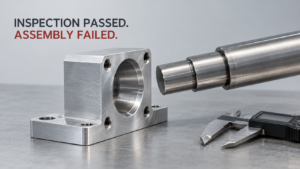
I ran a version of this test myself last year, sending the identical drawing — a 6061 aluminum bracket with a ±0.05mm critical bore tolerance — to three shops: one in Shenzhen, one in the Midwest US, and one in Ho Chi Minh City, all without disclosing I was comparing them. The Shenzhen shop’s first-article report came back with full CMM data and a Cpk calculation I didn’t even ask for. The US shop’s report was a hand-measured spot check on three dimensions. The Vietnamese shop skipped first-article inspection entirely and shipped straight to production. None of that tells you which country makes better machines — it tells you which supplier has actually built a quality system, and in that specific sample, equipment origin predicted nothing.
Action: Before you evaluate a single part sample, request the supplier’s first-article inspection report and Cpk data on a prior job. If they can’t produce one, the machine brand in their workshop photos is irrelevant.
Lead Times: Faster to Produce, Slower to Arrive
Lead time, properly measured, refers to total door-to-door time — production plus international logistics and customs — not just the days a supplier quotes for the parts to leave the factory. This distinction trips up more buyers than any other factor on this list. China’s domestic production speed is genuinely fast: prototype turnaround runs 3–7 days and batch runs of 100–1,000 units ship in 10–20 days, both faster than US shops (5–10 day prototypes, 15–30 day batches) [davantech] [yfcncmachining]. The catch is what happens after the parts leave the dock. Ocean freight to the US or Europe adds 20–35 days, and air freight — while faster — erodes most of the cost advantage you sourced offshore for in the first place.
Compare that to Mexico, where production lead times are similar (5–10 day prototypes, 10–20 day batches) but ground transport to the US takes just 3–7 days, and USMCA means zero tariff exposure versus the 25% Section 301 tariff that can apply to Chinese-origin parts entering the US [yfcncmachining]. Vietnam sits in an awkward middle: labor is cheaper than China ($4.5–6/hr vs $8–12/hr) [dewinvietnam], but the supply chain is shallower, and ocean freight timelines to the US or Europe mirror China’s 25–40 days [xtjcnc].
This is why “China is slow” and “China is fast” are both defensible statements depending on which leg of the journey you’re measuring. The production side genuinely outperforms most alternatives. The logistics side is where the total timeline gets away from buyers who only priced the factory quote.
Action: When you compare supplier lead times, always convert to a single landed-timeline number — production days plus realistic freight days plus customs buffer — rather than comparing factory-quoted days in isolation. A 12-day China quote and a 12-day Mexico quote are not the same commitment.
How China Stacks Up Against Other Sourcing Regions
Regional sourcing comparison refers to weighing cost, quality, lead time, and communication factors across countries as a package — not picking a single “cheapest” or “fastest” country and defaulting to it for every part. The 2026 regional data makes the trade-offs concrete. On 3-axis hourly rates, China ($20–60/hr) undercuts the US ($60–150/hr) and Western Europe (€60–120/hr, roughly $65–130) by half or more, while Vietnam ($9–18/hr) undercuts China again — but with a shallower supply chain and higher defect variance [yfcncmachining] [alloys-metal]. On 5-axis work, the gap compresses: China runs $60–140/hr against the US’s $120–300/hr, but Japan’s $35–55/hr looks cheap on paper until you account for higher material costs and longer lead times (10–20 day prototypes, 20–40 day batches) [yfcncmachining].
Communication cost is the factor buyers underweight most. China carries a 12–16 hour time difference from the US and a real language barrier in day-to-day technical back-and-forth [yfcncmachining]. Mexico’s 1–2 hour time difference and high English proficiency make it materially easier to run design iterations or catch a spec issue mid-production — a soft cost that doesn’t show up on a quote sheet but shows up in your project timeline. Japan is the hardest of the group on this axis: a 13–16 hour time difference stacked with limited English fluency, even though its quality ceiling is the highest in the comparison set.
None of these regions is categorically “better.” A US buyer running a cost-sensitive job with loose tolerances and no real-time design changes needed is leaving money on the table by defaulting to a domestic shop. A buyer running ITAR-controlled or AS9100-certified aerospace parts requiring constant engineering dialogue is taking on real risk by defaulting to the cheapest offshore quote. The right call depends on which variable in your specific job is actually the constraint — cost, tolerance, compliance, or iteration speed — not on a blanket “China vs. domestic” instinct.
Action: Before requesting quotes, rank your job’s constraints in order — cost, tolerance, compliance, lead time, communication — and let that ranking, not habit, determine which region you RFQ first.
Building a Sourcing Decision Framework You Can Actually Use
A sourcing decision framework refers to a repeatable checklist you run against every new part or supplier, rather than a one-off judgment call based on price alone — and it’s the difference between a sourcing strategy and a series of gambles. Four scenarios cover most hardware buyers:
Choose a Chinese supplier when your target price is 30%+ below US/EU quotes, you can absorb a 20–35 day ocean transit, and your MOQ sits in the 10–500 unit range where prototype turnaround (3–7 days) and batch runs (10–20 days) matter more than door-to-door speed [xtjcnc] [davantech]. China’s supply chain also handles 5-axis and complex surface finishing (anodizing, bead blasting) at production scale, which not every regional alternative can match [stylecnc].
Choose a US or Mexican supplier when lead time is the binding constraint — US domestic shops deliver in 5–10 days, Mexican shops in 7–15 days by ground — or when you need ITAR, AS9100, or ISO 13485 compliance that requires on-site audits and paper trails harder to manage across a 12-hour time difference [yfcncmachining].
Choose a German or Japanese supplier when your tolerance requirements sit at IT5–IT6 or your surface finish spec is below Ra 0.2, which shows up in semiconductor equipment, optical instruments, and precision medical implants where the cost premium is justified by the failure cost of a bad part [alloys-metal] [yfcncmachining].
Choose a Vietnamese supplier when tariff exposure is your primary problem to solve and you’re sourcing simpler 3-axis geometry, deburring, or basic finishing work where a marginally higher defect rate is an acceptable trade for avoiding Section 301 tariffs [dewinvietnam] [xtjcnc].
Whichever region you land on, run the same five-point check before you commit a PO: pull ISO 9001 certification and first-article inspection reports with Cpk ≥ 1.33 [szsinorise], verify the actual machine list including brand and axis count [stylecnc], confirm inspection equipment on the floor — CMM, roughness tester, hardness tester, spectrometer [szsinorise], nail down lead time terms in writing with a late-delivery penalty clause (0.5–1%/day is standard) [davantech], and — this is the step buyers skip most — calculate total landed cost, not factory quote: machining + material + finishing + inspection + freight + tariff + a quality-risk buffer [xtjcnc].
Action: Build this five-point check into your RFQ template as mandatory fields, not optional follow-up questions. A supplier who balks at providing any one of these five is telling you something before you’ve placed a single order.
FAQ
Q: Is it true that Chinese CNC parts are always cheaper than US-made parts?
A: Usually, but not automatically. Chinese 3-axis rates typically run $20–60/hr versus $60–150/hr in the US , but once you add 20–35 days of ocean freight and a possible 25% Section 301 tariff, the landed cost gap can shrink significantly on smaller orders or urgent timelines.
A: It matters less than most buyers assume — machine brand accounts for roughly 5% of quality variance, while process control and inspection capability account for about 40%. A well-run shop with domestic machines will consistently outperform a poorly managed shop with premium equipment.
A: Chinese prototype turnaround runs 3–7 days versus 5–10 days in the US and 7–14 days in Germany, and batch runs of 100–1,000 units ship in 10–20 days versus 15–40 days for Western suppliers. The advantage disappears once international freight is added to the total timeline.
A: For US-bound orders, yes, especially when lead time and communication matter. Mexican labor costs ($6–10/hr) are close to China’s ($8–12/hr), and USMCA gives zero tariff exposure plus a 3–7 day ground transit to the US versus China’s 20–35 day ocean transi. Material costs run 10–20% higher, though, and 5-axis capacity is more limited.
A: At minimum: ISO 9001 certification, a first-article inspection report with Cpk data, a documented machine and inspection equipment list, and written lead time terms with a late-delivery penalty clause.
A: Not yet, generally. Vietnam’s labor cost advantage ($4.5–6/hr) is real, but its supply chain is shallower and better suited to simpler 3-axis geometry and finishing work; defect rates on newer suppliers can run above 1.0% versus under 0.5% for established Chinese ISO 9001 shops. It’s currently a stronger fit for tariff mitigation on lower-complexity parts than for precision-critical work.