A surface finish can look right, pass inspection, and still fail in service. The purchasing mistake often happens before production: the specification names a process without defining the protection system.
“Black powder coating” leaves the substrate, pretreatment, coating chemistry, and acceptance criteria unresolved. “Zinc plated” does not identify the required thickness or supplementary treatment. “Passivated stainless steel” says little about whether the alloy suits the operating environment.
For global hardware buyers, the useful comparison is therefore broader than appearance, coating thickness, or salt spray hours. It connects the base material, manufacturing route, exposure conditions, dimensional requirements, and inspection evidence.
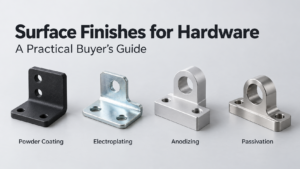
Powder coating, electroplating, aluminum anodizing, and stainless steel passivation all have practical roles. None is a universal upgrade. The objective is to purchase a finish that protects the actual component while preserving its fit, function, appearance, and commercial viability.
1. Surface Protection Systems: Match the Treatment to the Application
A surface protection system refers to the combination of substrate, surface preparation, treatment layers, finishing operations, and component design that determines performance in service.
The thickness figures alone show why these processes cannot be compared on one scale. Electroplated zinc thickness classes include 5, 8, 12, and 25 μm. Architectural anodizing classes in the supplied QUALANOD specifications include minimum average thicknesses of 10, 15, 20, and 25 μm. Stainless steel’s protective passive film is approximately 2–3 nanometers, equivalent to 0.002–0.003 μm. These figures describe different protection mechanisms, not a ranking from weakest to strongest. [American Galvanizers Association, Zinc Coatings; QUALANOD Specifications, 2025; worldstainless, Corrosion Resistance of Stainless Steels]
Powder coating provides a barrier and a controlled appearance. It suits many housings, brackets, fabricated assemblies, and architectural components where color and surface texture matter. However, the buyer must distinguish an indoor decorative application from an outdoor component exposed to sunlight, moisture, and damage.
The supplied research includes a polyester coating designed at 80 μm and an epoxy primer plus polyester topcoat system designed at 140 μm total thickness. These are study-specific systems, not universal purchasing limits. Their value is that they identify the construction behind the finish description. [Powder-coating study supplied in the research materials, PMC8585214]
Electroplating covers several different engineering choices. Zinc plating on steel provides sacrificial protection, while decorative nickel/chromium systems have different layer structures and service requirements. ASTM B633 addresses electrodeposited zinc on iron and steel; ISO 1456 addresses specified decorative nickel-containing coating systems. Treating both as interchangeable “plating” removes information needed for qualification. [ASTM B633; ISO 1456]
Anodizing converts the aluminum surface into an oxide layer. It can preserve a metallic appearance while providing corrosion and abrasion resistance. Architectural anodizing and hard anodizing serve different priorities, so a thicker oxide is not automatically the better purchasing decision. Alloy selection, appearance expectations, sealing requirements, and functional dimensions still matter. [Aluminum Anodizers Council, Anodized Aluminum FAQ]
Stainless steel passivation addresses surface condition. It helps remove free iron contamination and supports the corrosion resistance of a properly selected stainless alloy. It cannot turn an unsuitable grade into a suitable one or replace the removal of welding scale and associated affected surface material. [Euro Inox, Pickling and Passivating Stainless Steel]
The commercial opportunity lies in matching protection to exposure. A sheltered indoor bracket may not need the same treatment as an exposed coastal assembly. Conversely, a demanding outdoor application may justify a combined system rather than a nominally thicker single layer.
Action: Give suppliers the operating environment and substrate before asking them to recommend a finish, and require each quotation to identify the complete proposed system.
2. Corrosion Testing: Buy Defined Evidence, Not Salt Spray Hours
Corrosion qualification refers to the agreed test methods, specimen conditions, exposure periods, and acceptance criteria used to evaluate a specified protection system.
A requirement such as “500 hours salt spray” sounds measurable but leaves the purchasing decision incomplete. Does failure mean steel red rust, zinc corrosion products, blistering, pitting, or corrosion spreading from a deliberate scratch? Are cut edges exposed? Are suppliers testing finished components or separate panels?
ISO 9227 describes three salt spray methods: neutral salt spray, acetic acid salt spray, and copper-accelerated acetic acid salt spray. It does not set a universal exposure duration, specimen type, or interpretation of results for every product. Those requirements belong in the relevant product specification. [ISO 9227:2022]
ASTM B117 likewise provides a practice for operating salt spray apparatus. Naming it does not, by itself, define an acceptable hardware component. A complete purchasing requirement must connect the test to the failure conditions that matter for that part. [ASTM B117]
For zinc-plated steel, distinguish corrosion of the zinc coating from corrosion of the steel substrate. A report describing “no red rust” does not necessarily establish acceptable cosmetic condition. Whether visible zinc corrosion products are acceptable depends on the application and the agreed specification.
For powder-coated components, intact surfaces and damaged surfaces answer different questions. A flat, undamaged panel may demonstrate barrier continuity while revealing little about protection around scratches, edges, welds, or recesses. Buyers should establish which of those conditions the qualification must represent.
The supplied powder-coating study illustrates this distinction. Its findings differentiated performance under humidity and scribed conditions from performance on some unscribed salt spray surfaces. The procurement lesson is to examine the test configuration before accepting the headline result. [Powder-coating study supplied in the research materials, PMC8585214]
I have not conducted an independent corrosion experiment for this article. My assessment is based on the supplied research and referenced technical guidance. I would use those findings to define a supplier qualification plan, then validate the selected system on representative production parts before treating it as suitable for the application.
Buyers should also reject simple conversions between laboratory hours and field life. A statement that “1,000 hours equals ten years” needs application-specific evidence. It is not a general rule supplied by the salt spray method. [ASTM B117]
Salt spray testing still has value. It can support process control and identify coating discontinuities, provided comparisons use compatible systems, specimen preparation, methods, and acceptance criteria. Its usefulness falls when unlike materials are ranked through a single number. [ISO 9227:2022]
A better request asks for the report, specimen description, photographs, observed defects, and stated acceptance basis. This gives the buyer evidence that can be reviewed rather than a number that merely looks impressive.
Action: Rewrite every corrosion requirement to state the method, exposure duration, specimen condition, evaluation areas, and separate limits for each relevant failure mode.
3. Thickness and Fit: Specify the Finished Component
Finished-part dimensional control refers to managing the combined effects of machining, surface preparation, coating growth, and final inspection on functional dimensions.
Thickness can improve a protection system while creating an assembly problem. A satisfactory coating report does not establish that a pin fits, a thread engages correctly, or a contact surface performs as intended.
Powder coating illustrates the geometry clearly. If a hole receives a uniform 80 μm coating on each opposing wall, its diameter decreases by approximately 160 μm, or 0.16 mm. This is a geometric calculation using the coating thickness reported in the supplied study; it is not a measured production result. [Calculation based on the 80 μm design thickness in PMC8585214]
That reduction may be irrelevant for a generous clearance hole and unacceptable for a close fit. The drawing must distinguish the two. Otherwise, a supplier may satisfy the coating requirement while producing a component that requires drilling, scraping, or rework during assembly.
For deposited coatings, a useful starting estimate is that an external diameter increases by twice the coating thickness and an internal diameter decreases by twice that thickness. Actual deposition varies with geometry and process conditions, so the estimate should guide allowance planning rather than replace inspection.
Anodizing requires a different allowance model. The oxide grows partly into the aluminum and partly outward. The Aluminum Anodizers Council gives approximate inward/outward proportions of two-thirds/one-third for conventional Type II anodizing and one-half/one-half for Type III hard anodizing. These are guidance values; precision applications require agreement on actual process behavior. [Aluminum Anodizers Council, Anodized Aluminum FAQ]
Pretreatment also matters. Etching or other preparatory operations can remove material before oxide growth begins. Compensating only for nominal oxide thickness can therefore produce an incorrect final dimension.
Thickness acceptance itself needs precision. Under the supplied QUALANOD requirements, AA25 means a minimum average thickness of 25 μm and a minimum local thickness of 20 μm. Requiring “25 μm everywhere” would describe a different acceptance condition. [QUALANOD Specifications, 2025]
For electroplating, buyers should identify significant surfaces and measurement locations. An overall average can conceal insufficient coverage in a functional area or excessive buildup where clearance is limited.
Passivation generally creates no meaningful dimensional buildup for ordinary mechanical fits. However, a processing route that also includes pickling or electropolishing may remove metal. The buyer should establish which operations are included rather than infer dimensional neutrality from the word “passivation.” [Euro Inox, Pickling and Passivating Stainless Steel; worldstainless, Electropolishing Stainless Steels]
This creates an opportunity to reduce avoidable cost. Specifying functional surfaces precisely can prevent unnecessary masking, repeated handling, and corrective machining. Blanket requirements often force suppliers to process every surface as though it carried the same tolerance or cosmetic importance.
Action: Mark critical fits, masking boundaries, and inspection locations on the drawing, and state explicitly which dimensions apply after all surface processing.
4. Pretreatment and Substrate: Control What the Finish Cannot Hide
Surface preparation refers to the cleaning, contaminant removal, and substrate conditioning required before the specified protective treatment can perform reliably.
A finish description can conceal substantial differences in the underlying part. Bare steel, galvanized steel, aluminum, and stainless steel do not share one interchangeable preparation route. The coating name should never substitute for substrate identification.
In the supplied powder-coating study, the compared systems included an 80 μm polyester layer and a 140 μm primer/topcoat construction on galvanized steel. Those figures should travel with the substrate and preparation details whenever the results are discussed. Removing that context turns a system-specific result into an unsupported general claim. [Powder-coating study supplied in the research materials, PMC8585214]
For buyers, this means a successful qualification should establish a defined manufacturing route. A report for coated galvanized steel does not automatically qualify the same powder on bare steel. A supplier substitution may preserve color and nominal thickness while changing the basis of corrosion protection.
Edges, welds, recesses, and drainage deserve particular attention during review. These features can make a real bracket behave differently from a simple test panel. Ask whether qualification specimens represent the geometry and fabrication condition of the purchased component.
Electroplating raises another issue: mechanical integrity. For susceptible high-strength steel components, preparation and electroplating can introduce hydrogen-related risks. Applicable process controls must be addressed separately; a corrosion result cannot demonstrate that a loaded fastener is mechanically safe. [ASTM B633]
The practical purchasing response is to identify the base material, strength condition, and governing fastener or component requirements before approving the plating route. Treat corrosion resistance and mechanical performance as separate acceptance questions that both need suitable evidence.
Stainless steel presents a different boundary. Passivation is useful for contamination control, but it does not solve every surface defect. Welding heat tint and oxide scale require appropriate removal; ordinary passivation should not be accepted as a substitute for those operations. [Euro Inox, Pickling and Passivating Stainless Steel]
The underlying alloy and service conditions remain decisive. Chlorides, retained moisture, and crevices can challenge stainless steel despite a clean surface. A passivation certificate therefore cannot stand in for material selection or component design review. [worldstainless, Corrosion Resistance of Stainless Steels]
For anodized aluminum, alloy and starting surface condition also belong in the approval package. A finish sample made from a different alloy or fabrication route may not represent the production appearance.
These controls create room for better sourcing. Suppliers can propose alternative preparation routes, but changes should be evaluated against the approved outcome and requalification needs. A technically justified alternative is useful; an undocumented substitution prevents meaningful comparison.
Action: Require each supplier to document the substrate, preparation route, and permitted process substitutions, with approval required before changes affecting the qualified system.
5. Procurement Specifications: Turn Requirements into Acceptance Decisions
A verifiable procurement specification refers to a purchasing document that connects application needs with defined materials, process requirements, inspection evidence, and acceptance rules.
Consider two hypothetical descriptions. “Black powder coating, 1,000 hours salt spray” leaves most acceptance decisions unresolved. A stronger description identifies the substrate, preparation, coating construction, appearance reference, finished dimensions, test configuration, and permitted defects. The example’s exposure duration is a purchasing placeholder, not a recommended universal requirement.
The same discipline applies across all four treatment families. For zinc plating, specify the applicable coating designation and supplementary treatment. For anodizing, identify the class, sealing requirements, significant surfaces, and appearance expectations. For stainless steel passivation, define the material and applicable treatment and verification requirements. [ASTM B633; QUALANOD Specifications, 2025; ASTM A967/A967M]
The best RFQ separates requirements into a sequence that suppliers can answer consistently.
Start with service conditions: indoor or outdoor use, salt exposure, wetting, cleaning chemicals, wear, and appearance expectations. Describe the component’s actual duty rather than relying only on broad labels such as “marine quality.”
Next, identify the material and geometry. Include the alloy or steel grade, fabrication condition, welds, critical edges, mating surfaces, and features that require masking. This lets the supplier evaluate whether the requested treatment is practical.
Then define the finish construction and measurable outcomes. Where an approved performance-based alternative is acceptable, say so. Where layer chemistry or thickness is essential to interchangeability, state it directly.
Finally, define the evidence required for acceptance. A report should identify the tested parts or specimens, processing condition, test method, results, and acceptance basis. The buyer should be able to connect it to the supplied lot or approved qualification.
Keep appearance approval separate from corrosion approval. A color sample establishes a visual reference; it does not establish coating durability. Similarly, a corrosion report does not determine whether texture, gloss, or visible defects meet the customer’s expectations.
Commercial comparisons should follow technical normalization. A lower quotation may reflect a leaner but adequate system, or it may omit preparation, masking, inspection, or supplementary treatment. Buyers need those differences visible before comparing landed prices.
Ask suppliers to identify deviations explicitly. A clear exception can be evaluated before production; an assumption discovered after shipment becomes a dispute.
The opportunity is a more competitive supply base. A specification that states what matters allows capable suppliers to explain process options while preserving consistent acceptance. It also reduces the risk of paying for impressive numbers that do not address the component’s actual failure modes.
Action: Issue one common technical specification with every RFQ, require a written deviation list, and compare commercial offers only after the proposed systems have been technically aligned.
Frequently Asked Questions
A: There is no universal winner. Start with the substrate, exposure, geometry, appearance, and functional requirements. Powder coating, zinc plating, anodizing, and stainless steel passivation protect different materials through different mechanisms. Select and qualify the complete system.
A: Not automatically. Salt spray results need a defined method, specimen condition, and failure criterion. ISO 9227 does not position these tests as a universal method for ranking different materials or predicting long-term corrosion resistance.
A: No. Greater thickness may help a particular system, but it can also affect fit and does not replace preparation, adhesion, sealing, or defect control. Specify a justified thickness range and finished dimensions rather than requesting the maximum available buildup.
A: Yes. Passivation cannot compensate for an unsuitable alloy, aggressive exposure, or unresolved fabrication problems. Review material selection and surface condition together, particularly where salts, retained moisture, or crevices are present.
A: A report supports only the scope its specimens and processing conditions represent. Check differences in substrate, coating construction, geometry, and manufacturing route. Establish what requires renewed qualification and what routine evidence is needed for production acceptance.
A: Request the complete finish specification, declared deviations, representative samples, relevant qualification evidence, and a finished-part inspection plan. Ensure the documents identify functional dimensions and acceptance criteria clearly enough that both parties can reach the same decision on a shipment.