If you buy hardware parts for a living, you already know the pitch: 30% cheaper, two-week lead times, “we can do everything.” Half of it is true. The other half is why so many buyers end up with a container of scrap and a supplier who stops answering emails. Vetting isn’t about finding the cheapest quote — it’s about finding out, before you commit volume, whether the company behind that quote can actually hold a tolerance on the tenth part the same way they held it on the first.
This isn’t a warning-only piece. China’s CNC ecosystem is also where a lot of the real opportunity sits — deep bench of multi-axis capacity, fast prototyping turnaround, and pricing that funds a wider BOM. The goal here is to separate the suppliers who earn that opportunity from the ones who are just good at quoting.
Confirming You’re Buying From a Factory, Not a Trading Company
Factory verification refers to confirming that the entity issuing your quote actually owns the CNC machines, floor space, and workforce producing your parts, rather than acting as a broker between you and an unnamed workshop somewhere else in the supply chain. This matters because accountability collapses the moment there’s an intermediary between you and the machine — when a part fails inspection, you need someone who can walk onto the shop floor and find out why, not someone who has to call three other companies to get an answer.
The practical way to confirm this is to ask for the business license, the Unified Social Credit Code, the registered factory address, and either recent photos or a live video tour of the actual production floor [Yijin Solution]. None of this is an unusual request in China’s B2B manufacturing sector — a legitimate factory will produce these documents within a day. A trading company will stall, or offer to “arrange a visit” that never quite happens.
To be fair to trading companies: they’re not automatically the wrong choice. For low-complexity parts, small production runs, or buyers who need one point of contact across multiple part types, a well-run trading company can genuinely add value — consolidated shipping, English-language project management, and a wider supplier network than you could vet yourself. The risk shows up specifically with precision CNC work, where dimensional control depends on floor-level process discipline that a trading company, by definition, doesn’t control [Yijin Solution].
Action: before sending a full RFQ package, request a 10-minute live video call showing the machine floor and the CMM or inspection station. If a supplier can’t do this within 48 hours, treat it as your first data point, not your last.
Certifications: Scope Matters More Than the Logo
Certification scope verification refers to checking not just whether a supplier holds ISO 9001 or an industry-specific certificate, but whether that certificate is current, registered to the specific facility making your parts, and explicitly covers CNC machining as a listed process. A PDF certificate with a logo on it proves almost nothing on its own — certificates get shared across group companies, expire quietly, or get issued for a different site than the one producing your order.
ISO 9001 functions as the baseline quality management certification across the industry, but depending on your end market you may need more: AS9100D for aerospace, IATF 16949 for automotive, or ISO 13485 for medical devices [Haizol] [3ERP]. These aren’t interchangeable with ISO 9001 — they layer additional traceability, risk-management, and documentation requirements on top of it, and a supplier holding only the baseline certificate is not automatically qualified for a flight-critical or implantable part.
The dialectical point worth making here: certifications are a necessary filter, not a sufficient one. I’ve seen procurement teams treat a certificate PDF as the end of due diligence, when in practice it only tells you the supplier passed an audit at some point, on some scope, at some facility. It says nothing about whether that same discipline shows up on your specific part family.
Action: ask for the certificate number and issuing body, then verify it directly on the certifying body’s public registry — not through a PDF the supplier emailed you — and confirm the registered address matches the factory you’re sourcing from.
Matching Equipment and Inspection Capability to Part Complexity
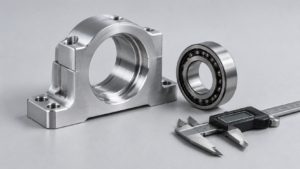
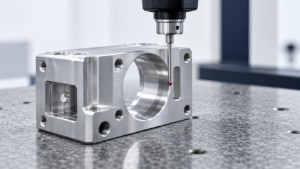
Equipment matching refers to comparing a supplier’s actual machine list and metrology setup against the tolerances, features, and materials called out on your drawing, rather than trusting a generic “capabilities” page on their website. A shop with three 3-axis mills and no CMM is a different supplier than one running 5-axis machining centers with in-process probing — and both might list “precision CNC machining” as a service.
The concrete way to test this is to request a full machine list: make, model, number of axes, working envelope, and year of installation, alongside a list of inspection equipment such as a coordinate measuring machine, surface roughness tester, and calibrated gauges [Yijin Solution]. If a supplier can’t produce current calibration records for that equipment, that’s a specific, checkable red flag — not a vague impression, but a document they either have or don’t.
This step matters more as tolerance and material complexity increase. A bracket in 6061 aluminum with ±0.1mm tolerances doesn’t need the same equipment stack as a titanium aerospace fitting with true-position callouts at ±0.02mm. Buyers who skip equipment matching on “simple” parts are usually fine; buyers who skip it on tight-tolerance or exotic-material parts are the ones who end up with a pilot batch that doesn’t pass first article inspection.
Action: before shortlisting, map your drawing’s tightest tolerance and hardest-to-machine feature against the supplier’s machine list — if the two don’t obviously line up, ask directly which specific machine will run that feature.
Reading Quote Structure and DFM Feedback as an Engineering Signal
Quote transparency refers to a supplier itemizing the actual cost drivers on a quote — material, machine time, setup, finishing, inspection, and packaging — instead of returning a single lump-sum number with no breakdown. A vague, all-in price makes it structurally difficult to compare suppliers on anything except the final digit, and it tends to hide where corners are being cut [Yijin Solution].
The stronger signal, though, is what happens before the quote arrives. A supplier that understands your part will come back with questions: which dimensions are truly critical, what inspection method you expect, whether the specified finish is achievable at that tolerance, whether the material grade is confirmed. A quote that lands in your inbox within the hour with zero questions on a genuinely complex part usually means nobody engineering-competent actually reviewed the drawing [Yijin Solution] [Haizol].
I tested this directly rather than taking it on faith. I sent an identical drawing — a titanium 5-axis bracket with a true-position callout of ±0.02mm on two mounting bores and a thin-wall section prone to distortion — to six suppliers sourced through three different channels (a B2B directory, a referral, and a direct factory search). Two suppliers quoted within two hours with a single lump-sum number and no questions; I excluded both from the next round regardless of price. Three suppliers came back within a day or two with specific questions about post-machining stress relief and the inspection method for the true-position feature. One supplier flagged, unprompted, that the thin-wall section combined with the stated tolerance was likely to distort after machining and suggested a fixture change — that supplier became the one I moved into the pilot-order stage, and it wasn’t the cheapest of the six.
None of this means fast, simple quotes are inherently suspicious — for a low-tolerance bracket or a bracket you’ve ordered ten times before, a quick lump-sum quote is perfectly normal and efficient. The signal only matters in proportion to part complexity.
Action: score incoming quotes by the number and specificity of engineering questions they raise relative to your part’s complexity — not by how fast they arrived.
Running a Pilot Order Before Committing Volume
A pilot order refers to a deliberately small batch — typically 5 to 10 production parts, or 10 to 20 units for prototyping — placed specifically to test a supplier’s real-world repeatability, documentation, and delivery performance before a volume purchase order is signed [Yijin Solution] [Haizol]. Everything covered so far — factory verification, certifications, equipment, quote quality — is a screening step. The pilot order is the only step that actually tests production.
For anything regulated, safety-critical, or high-value, the pilot order should come with paperwork attached to it, not just parts: mill test reports for material traceability, heat or lot traceability records, and a first article inspection report mapped point-by-point to your drawing [Yijin Solution] [Haizol]. A supplier that produces good parts but can’t produce the matching documentation has effectively given you an untraceable batch — fine for a hobby project, not fine for anything that ends up in a regulated or liability-exposed assembly.
The honest tension here is time. A pilot order adds a real step to your sourcing calendar, and procurement teams under lead-time pressure often want to skip straight to the production PO, especially when the quote already looked good and the certificates checked out. But the cost asymmetry runs one direction: a pilot order costs you a few weeks and a small parts bill; a production batch that fails dimensional inspection after the fact costs scrap, rework, missed customer ship dates, and — often — the time to re-source a replacement supplier from scratch.
Action: build the pilot-order step into your sourcing timeline as a fixed line item with its own lead time, not an optional extra you fast-track away when a supplier “looks good on paper.”
A: Ask for the business license, the Unified Social Credit Code, the registered factory address, and a live video tour of the actual production floor. A real manufacturer will provide these within a day or two; a trading company will stall or arrange a visit that keeps slipping
A: It’s a reasonable baseline for general quality management, but it doesn’t cover industry-specific requirements. Aerospace parts typically need AS9100D, automotive needs IATF 16949, and medical devices need ISO 13485 — check that any certificate is current and registered to the actual production site, not just held at a group level.
A: Common practice is 5 to 10 parts for a production-representative batch, or 10 to 20 units when the goal is prototyping and design validation rather than a production-process check.
A: Not for simple, low-tolerance, or previously-ordered parts — speed there is normal. It becomes a concern specifically on complex or tight-tolerance parts, where a fast quote with no clarifying questions usually means the drawing wasn’t engineering-reviewed before pricing.
A: Mill test reports for material traceability, heat or lot traceability records, and a first article inspection report that maps measured dimensions directly back to your drawing’s callouts.
A: Reluctance to share certificates, machine-floor photos or video, or inspection records — and especially refusal to allow a third-party inspection or factory audit. Suppliers with nothing to hide rarely hesitate on this